
The Poetry of Protest: Poets for Palestine

Linda Abdullah defines “genocide” to an empathetic audience May 11, 2024. (Photo by C. Schandelmeier). 
Sahar Mustafah was the emcee for “Poets for Palestine” sponsored by Exhibit B and the Guild Literary Complex. (Photo by C. Schandelmeier) 
Alex Wells Shapiro signs copies of his book for eager audience members. Find out more about Shapiro at https://www.alexwellsshapiro.com/about (Photo by C. Schandelmeier). 
IS Jones, poet, gave a compelling reading at the event. (Photo by C. Schandelmeier) 
Lynn Fitzgerald enjoys a lively post performance conversation with poet/performer Oliver Khan, who is a lawyer by day and lives in Lombard with his family. (Photo by C. Schandelmeier) 
The audience at the event was captivated by the poetry performers. While poet Amina Kayani (bottom, center) patiently awaits her turn. (Photo by C. Schandelmeier) 
Volunteers took good care of thirsty audience members during the brief intermission. (Photo by C. Schandelmeier) 
Poet Amina Kayani (far right) shares information with eager audience members at Co-Prosperity located on S. Morgan Street in Chicago. (Photo by C. Schandelmeier) 
Best friends Emily and Alanis met in high school while performing poetry. (Photo by C. Schandelmeier) 
Delighted audience members enjoyed refreshments during the brief intermission. (Photo by C. Schandelmeier) 
Poets Alex Wells Shapiro and Oliver Khan enjoy the breakl (Photo by C. Schandelmeier) 
Poets for Palestine performers, IS Jones, Sahar Mustafah, Oliver Khan, Alex Shapiro, Linda Abdullah, and Amina Kayani pose for a group shot after their historic performance on May 11, 2024. (Photo by C. Schandelmeier) 
Andrea Change, Executive Director of the Guild Complex smiles after the conclusion of the successful event. (Photo by C. Schandelmeier)
Protests, teach-ins, encampments and poetry readings, the people of Chicago – and the world – are doing everything they can to create change for Gaza. There is little that is more complex or harrowing than what is happening between Israel and Palestine right now, and poetry is a concise means to convey complex emotions. On Saturday, May 11th, at Co-Prosperity, 3219 S. Morgan, there was a poetry reading hosted by Exhibit B and the Guild Literary Complex titled Poets for Palestine which featured several heavy hitters in the world of poetry, Linda Abdullah, Oliver Khan, Safar Mustafah, Amina Kayani, Alex Wells Shapiro and IS Jones. All of these world-class poets contributed poetry performances with the goal of helping the Palestine Children’s Relief Fund provide essential aid to the war-torn region. The poets were grateful that college students (beginning with those at Columbia University in New York, and ending with the encampment at DePaul University here in Chicago) have stood up and made themselves heard across the world for the cause of peace in Palestine.
Protests and Encampments

Merawi Gerima with the Chicago Alliance Against Racist and Political Repression can be found on Instagram @caarprnow or @gerima_gang, and elicits a call response from the youngest member of the protest in front of the 19th District of the Chicago Police Department on Sunday, May 19, 2024. (Photo by C. Schandelmeier) 
Palestinian Flags fly against the Chicago sky on Sunday, May 19, as protesters hold a sign saying “What did the Chlidren Do to Deserve This?” (Photo by C. Schandelmeier) 
Free Gaza is one of the many signs on the campus of Northwestern University in Evanston on April 30th, 2024. 
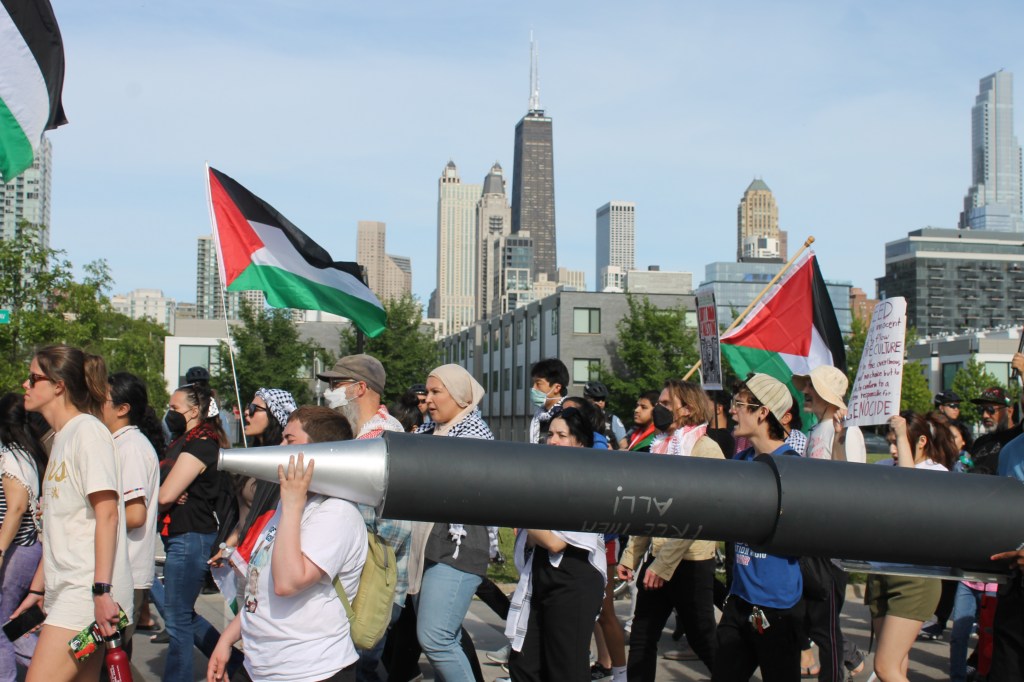
Protesters March to the 19th District on the Near North side of the Chicago Police Department on Sunday, May 19th, 2024. (Photo by C. Schandelmeier) 
Protesters young and old march to the Near North side Chicago Police District offices carrying signs as the John Hancock building and the famous Chicago skyline towers in the background. (Photo by C. Schandelmeier)
During a protest for Palestine that was held on Sunday, May 19th, Anatasia Colon, a cousin of a DePaul University student who participated in the encampment spoke about the experience, “It was 5:34 in the morning when we got word that the police were coming to disperse the camp. They didn’t wake us, we woke ourselves up, and got out of there on our own.” As she spoke, representatives from a number of Chicago-based organizations including Chicago Alliance Against Racist and Political Repression and Cultural workers for Palestine stood in peaceful protest on the premises of the 19th District Near North Chicago Police Department.
Poetry for Palestine is inspired Internationally
The issue of the Isreali-Palestine conflict has had international impact. Halima Zakhir was raised in America, but has made the choice to raise her own family in India. Her poem is pictured here from her Instagram account with permission. In response to using her poem this article, she wrote, “I do not have enough words for this genocide… We have waited so long for this tragedy to catch up with the rest of the world. It has certainly taken too many lives and too long of a time to bring notice, but nevertheless, every revolution starts somewhere.”
Zakhir continued, “Hopefully, through the raw emotion of poetry, more people are made aware of the cause. What I wish for is my poetry, my art to stoke a passion in the outside world that will call for supreme justice. Because what no man can achieve through sheer talk, anyone can achieve anything through the force of art, be it poetry or paint or photography.”

A Chicago poet and activist, Alexis Judeh is half Palestinian and half Mexican. She was raised in large part by her Palestinian Grandfather, a larger than life character who brought a love of Palestine to America with him, and shared that love with his grandchildren. While he has passed on, Judeh remembers him fondly, and honors his memory through the art she creates with her sister, Yolanda, who helped her write the following poem for the International Day of Peace at CodePink Gallery.

Palestinian/Mexican artist Alexis Judeh created this artwork for a September 21, 2023 International Day of Peace exhibit for Code Pink. To find out more about this event, visit https://www.codepink.org/peace_gallery (used with permission by the artist, Alexis Judeh).
Gladiators in Keffiyehs
From Monterrey and Betunia soil
Birthed children of die-aspra
Madre from Palestine
We the products of colonial uprooting
Our seas polluted with killing machines
The dead sea is a burial ground
Identities bruised by displacement
Pain engraved in our blood cells
There are no welcome mats at U.S. doors

Bandannas and Keffiyeh wrapped around our face
Mexican and Palestinian flags wrapped around our chest
Living flesh with stories inherited through blood
Lineages of resistance that slip through tongue

So we protest
Command the capital to listen
We’re here to stop U.S. dollars from blowing our home towns to dust
Sick of seeing things from a distance
Rusted metal standing on sacred ground
Covering gold and open sky domes
We’re just traveling prisoners
Exiled from the fruit of our labors
We hear the cries of our ancestors calling
So we answer
We are gladiators in Keffiyeahs
We’re here to dance dabka on the throats of our oppressors
Zapateado on their colonial graves

Empires have expiration dates too
We are protectors like David
Stone in hand
And even then
They want us to build bridges
Build bridges?
Nahhhh we tearing down walls
From Palestine to Mexico border walls have got to go

We look this country in the eyes and America
Medusa’s us to stone
This is what happens when you tell a murderous
Nation that
Their 50 states are 50 snakes
Our voices submerged in cement
Our mouths made rock
When all you are limestone
You have no choice but to watch wreckage
Through frozen pupils
You don’t know how hard it is to watch
When soil you stand on supplies the ammo for our for our country’s annihilation

Millions of billions of dollars
And rubble turns into oblivion
400 Palestinian towns erased
Our catastrophic displacement
Maps redrawn in their favor
And countless bloodshed later
Still liberation seems so far
How many intifadas will it take?
Children branded from rubber bullets
That read Pennsylvania
Their lifeless bodies on grounds our ancestors cultivated
Olive trees waters with our own blood
Forced removal
Suffocating living cargo

We hear the cries of our ancestors calling
So we answer
We are gladiators in Keffiyehs
Our loyalty lies with unseen soil
Keepers of untasted fruit
We bare the courage of our ancestors
Carry it on our skin
We know we are more than your oppression,
Checkpoints and walls
We exist outside of your lens
We are the culture you desire
If not, you wouldn’t have stolen it
But there are things apartheid cannot eradicate
We are living proof.
- Alexis and Yolanda Judeh
(The poem was written and performed for the International Day of Peace event at Codepink on September 21, 2023. The artwork that preceeds it was created for the same event).
There have been demands for disinvestment and plans for peace, but with little food and constant bombardment, the remaining people of Palestine are barely surviving. Macklemore is one rapper to address the issue in his new song Hinds Hall. He also read a poem for Gaza at a recent concert, but that’s just the tip of the iceberg. Poets are stepping up and showing out to make the voiceless people of Palestine be known. For example, Gregorio Gomez, who has no biological connection to Palestine, composed a poem titled Words of Defiance which he performed in March at Tangible Books, hosted by Vittorio Carli. One does not need to be Palestinian to understand the very real human toll of what is happening in Gaza.
To find out more directly from the Palestinans themselves, look for Judeh’s friend, Fadel in Gaza. He keeps the world updated through his Instagram account at fadelmoghrabi. Meanwhile, in Chicago and throughout the world poets are working to enlighten curious minds about what is happening in Palestine. Look for Alexis Judeh’s next poetry reading with the Beach Poets on June 16th at 1:30 pm, at Loyola Beach or look for the Poetry to Free Gaza Facebook fan page.

Alexis Judeh is a graduate of DePaul University. A former teacher, she is currently a counselor in a homeless shelter, while she pursues her poetry, art and activism on behalf of Palestine. She is pictured here on the campus of Northeastern Illinois University, where she had arrived for an interview with WZRD Chicago 88.3 FM. (Photo by C. Schandelmeier) 
Alexis Judeh admires the Sharon Hahs Garden outside of the Ronald Williams Libarary on the campus of Northeastern Illinois University, where she had arrived for an interview with WZRD Chicago 88.3 FM. (Photo by C. Schandelmeier) 
Alexis Judeah was excited to see the WZRD for Palestine poster up outside of the radio station on May 21, 2024. (Photo by C. Schandelmeier)
 Poetry in Chicago