Chicago’s Poetry News

  • “When the Night Finds You” by Dwight Okita

    “When the Night Finds You” by Dwight Okita

    Dwight Okita performs When the Night Finds You video shot and edited by C. Schandelmeier, March, 2024.

    “When The Night Finds You” by Dwight Okita

    It is Oscar night, and a blue heaven of the miraculous surrounds Dwight Okita as he opens his door to his 29th floor studio condominium, an island in the sky of Chicago, where he writes, works, and dreams.  He offers a chair, the city cloaked in night, and sparkling below. As the evening progresses, The 2024 Academy Awards are disappointing for Okita because Oppenheimer’s Oscar sweep was a tragedy for Barbie. He was also rooting for the director to at least win for Best Adapted Screenplay, but not this time. American-born, third generation Japanese, Okita has insider knowledge about what happened when the bomb dropped, having co-authored a Joseph Jefferson award-winning play with Nick Patricca, Anne McGravie and David Zak titled The Radiance of a Thousand Suns: The Hiroshima Project  (1995) which may be the reason why the Oppenheimer win rankles. 

    He shares some of the ramifications of the dropping of the bomb on Japan: the fact that most of the people who were killed were ordinary citizens, the flesh that literally came off their bones when touched, the imprint of a kimono pattern word at the time of the blast permanently seared into the skin of the wearer. By contrast, the hope-filled promise of Barbie gives the post-pandemic audience a reminder of what happiness feels like. For the author of The Hope Store (2017), this is understandably important.
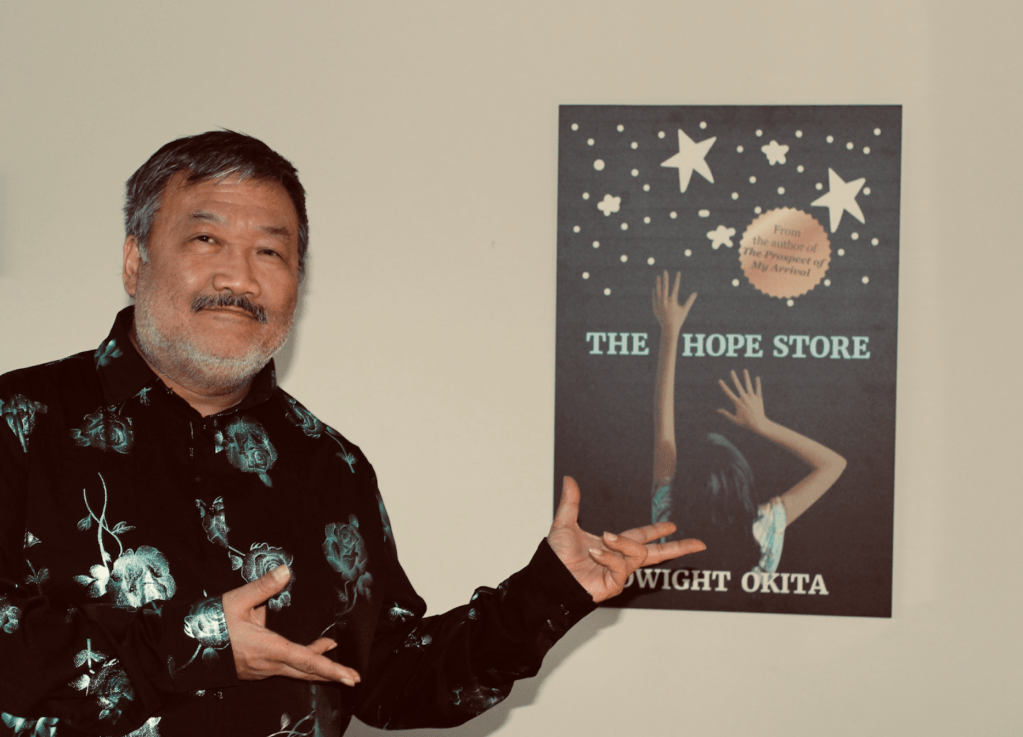
    Dwight Okita points out the larger than life version of the cover for his 2017 novel, “The Hope Store.” (Photo by C. Schandelmeier, March 10, 2024).

    “Let’s break it down, Cathleen,” he said. “Oppenheimer is about a white man who feels a little bad about creating a bomb that could’ve destroyed the world – and did destroy tons of Japanese civilians. A story of white guilt. Barbie is about a female doll that has an existential crisis when she realizes that humans actually die. She makes a decision that I found moving and heroic. Barbie was the movie the world didn’t know we needed to see! It was entertaining and hopeful after the endless pandemic.”
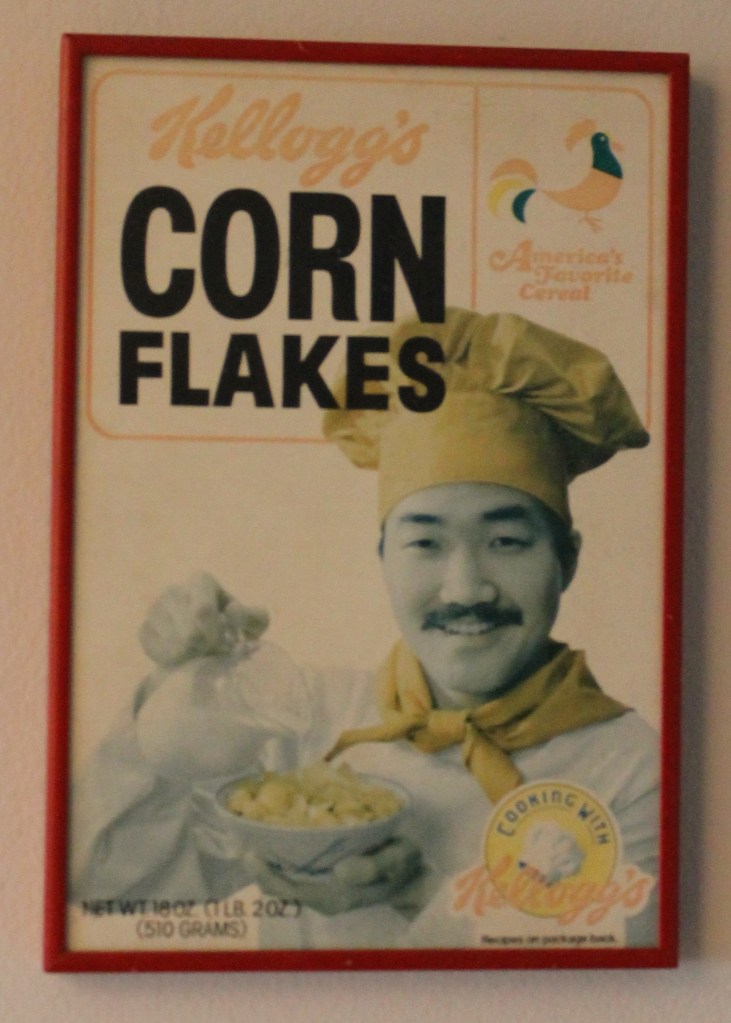
    Dwight Okita’s cover on the Kellogg’s Corn Flakes box is proudly displayed in his Chicago home. (Photo by C. Schandelmeier, March, 10, 2024)

    Okita shared a story about appearing on the cover of the Corn Flakes box. “Dad was a grade school teacher and he bought twenty boxes. He had me autograph them for his fellow teachers,” he said concealing a smile. Oddly, his father was less boastful about the first poem Okita got published, perhaps because it was in a small Chicago publication, whereas the cereal box was Kellogg’s after all. The poem “In Response to Executive Order 9066 (which refers to the order that caused Japanese Americans to be forcibly removed from their homes, and interned during World War II) went on to be included in scores of textbooks and in the Norton Introduction to Literature. 

    Okita has it, the gift of poetry, the ability to weave magic with words, the unique perspective of someone who tackles issues head-on while viewing them dreamily, from a distance in his fantasy land in the sky, where the dream factory of Hollywood colors and impacts  his very real life. To learn more about Dwight Okita or his book go to his website at dwightokita.com.

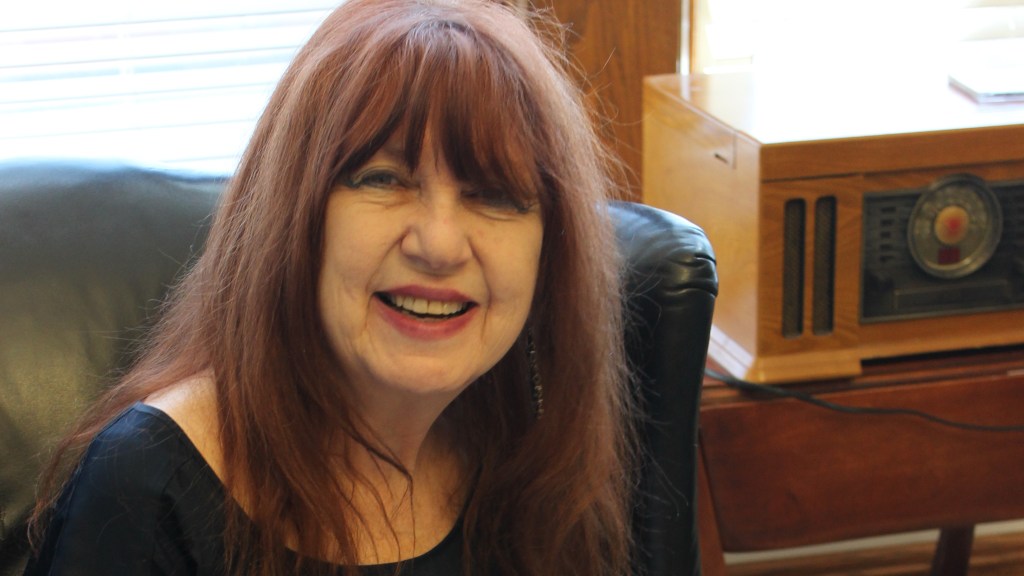
    Dwight Okita in his Chicago home on the 29th floor. (Photo by C. Schandelmeier, March 10, 2024).
  • Lynn Fitzgerald: Irish Rebel Poet

    Lynn Fitzgerald: Irish Rebel Poet

    By C. Schandelmeier

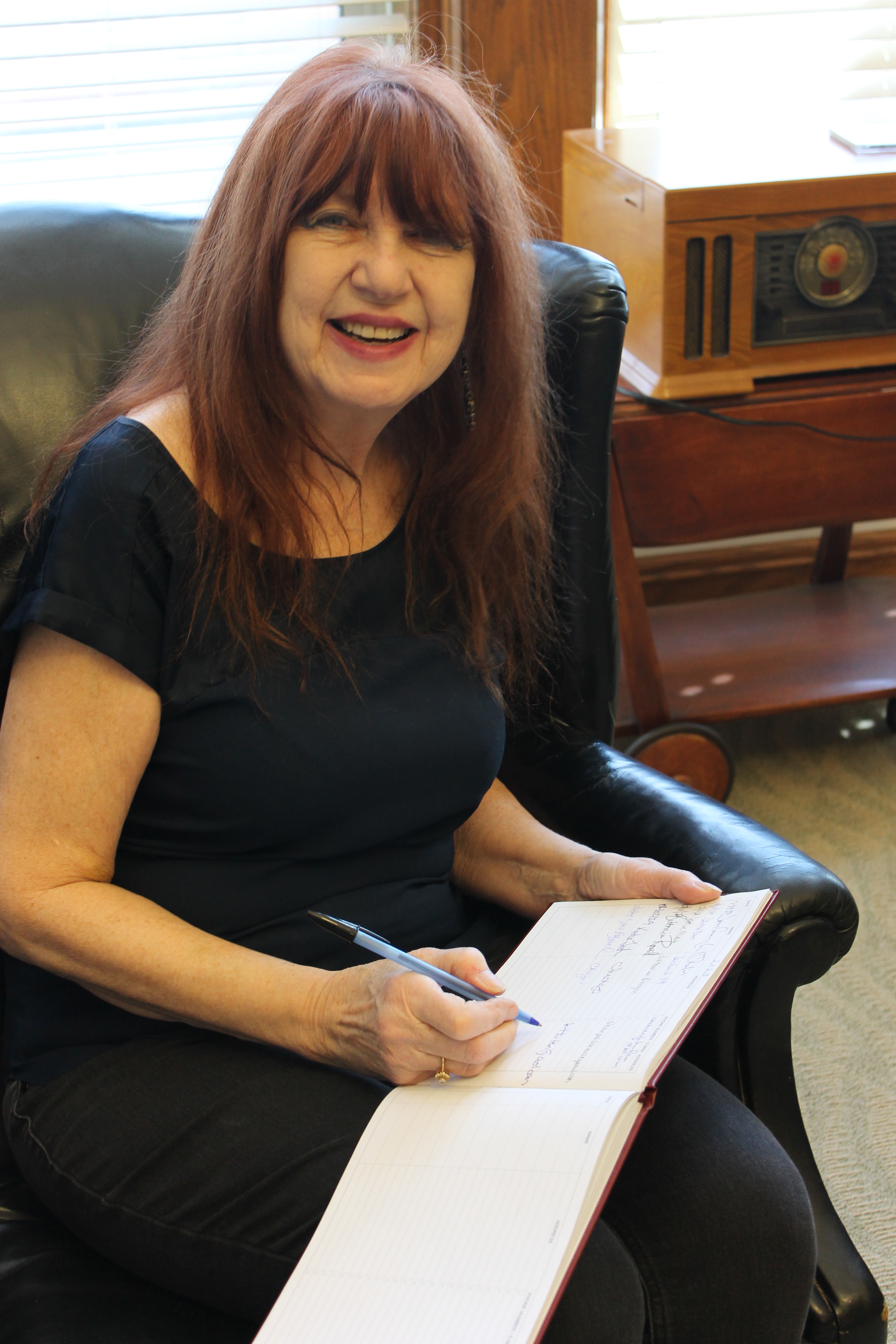
    Poet Lynn Fitzgerald is a modern day outlaw poet, pulling up in a vintage 1997 emerald green convertible Jaguar. The accelerator on the car is so sensitive that before she knows it, she is traveling over the speed limit. Life in the fast lane is no surprise to Fitzgerald, who is a true daughter of Ireland, at once brave and humble, outrageously stylish and brilliantly brainy. Lynn Fitzgerald grew up in Chicago, while tightly bound in the culture of her heritage, though her mother, (a World War II “war bride” shipped in at 19 directly from the Emerald Isle) denied she was from anywhere but Chicago. Is it any wonder that as a young woman in college at Loyola University,  Fitzgerald met her future husband in Loyola’s library. She fell in love with a man who was a Palestinian immigrant, studying politics and history. 

    Their passion helped to change the world. Together, they were members of Teatro Barrio, housed in the original Casa Atzlan in Pilsen, where  performances and readings were staged in Spanish and English. These events depicted the struggle for better wages and conditions for farmworkers, and led to the national boycott of grapes, bringing nationwide attention to the United Farm Workers (UFW). They also were part of Bread and Roses Theatre, and staged a play about the 1937 Sit  Down Strike in Flint, the biggest strike in the 20th century, resulting in the United Auto Workers (UAW) becoming a nationwide labor union, which paved the way for the Steelworkers to unionize. They were involved in theatrical renditions of critical events in history (her husband’s area of specialty). In love, this dynamic young couple brought history to the people and changed lives. Love is what drew them together, and life is what pulled them apart. 

    After their divorce, Fitzgerald, who had few role models of single mothers, suddenly found herself engulfed in teenagers as she was raising her children by herself and teaching teens, too. During this time, she was a teacher (now retired) for Chicago Public Schools. She taught English at Prosser Career Academy, in the International Baccalaureate and Advanced Placement programs, as well as at Roberto Clemente Community Academy High School’s evening school for over 20 years. She edited the literary magazine, taught creative writing, and was one of the original high school coaches for the poetry slam in Chicago. Subsequently, she has moved on to become an adjunct professor at City Colleges of Chicago. Nothing grounds a mother like her children, and Lynn’s children are no exception. They both (though now grown) have faced incredible blowback from their Palestinian heritage during the current Israeli-Hamas war, even though their father passed away two years ago. 

    She has taught not only here but abroad, in China, Kuwait and Beirut. One minute will find her reading her captivating poetry to a packed house at a poetry venue, the next, dashing to teach a class, or create a lesson plan on the likes of the beginning of cinema, with A Trip to the Moon by Georges Méliès.  Fitzgerald is not bound to the conventions of society, and finds inspiration and motivation by spending time with nature, where she finds the most solace and connection.  It is no wonder that her 2011 chapbook of poetry was titled “Closer to the Earth.” Fitzgerald is currently at work writing a manuscript of new poetry as yet untitled. To reach her or find out more, go to her Tumblr account Marycelle.

  • The History of Hip Hop with Emcee Monte

    The History of Hip Hop with Emcee Monte

    Welcome to the first-ever podcast for Poetry in Chicago (<-click here to hear it!) We are looking into the history of hip hop today, with Emcee Monte, who is also known as Monternez Rezell. In “Jammin’ with the Boombox, Volume 2: 50 Years of Hip Hop” he has created a poetic album that is rooted in Hip Hop culture, and funded by a grant from the city of Chicago’s Department of Cultural Affairs and Special Events, (commonly known as DCASE.) His journey into Hip Hop began at Kenwood Academy High School on Chicago’s Southside

    “The University of Hip Hop and my mentors. Lonnie Raven and Hector  really gave me the foundation of the culture, so not only was I practicing how to be a Beat boy or how to break dance or practicing rapping, or practicing graffiti, practicing rapping. I was really engulfed in the culture of hip hop and all of the elements, and learning the history, learning the importance of knowing my foundation and the founders of the culture, and being a part of the legacy of hip hop, and not just being on the side rapping and thinking “I’m gonna rap! I’m the best rapper!” But  being a part of the community as a whole, and contributing to Hip Hop culture. Not just participating in one thing. Not just being on the sidelines, but participating in the culture and passing it down to the next generation.  My mentors taught me, and now it is about being the best mentor I can be to the next generation” 

    – Emcee Monte

    Poetry in Chicago: Tell us something about the history of Hip Hop since you are so well versed on it. 

    “One of the things that you need to know is that hip hop started in New York City in the Bronx, DJ Kool Herc is credited with inventing the first break beat in that moment, in that year in 1973. When DJ Kool Herc revealed his merry go round technique, and that was the catalyst for the bridge to bring all of the elements of hip hop together. That creation of breakbeats sparked the moment and growth of  break dance and creating break dance to go with the break beats and those two things were the birth that inspired the growth with the hip hop culture. From there, you add the emcee, and the other elements. But now, hip hop culture has come to be more and more popular and become a force within the music industry. Now, as we know, it is one of the most popular styles of music in the world, rap and hip hop music has now surpassed rock music in being one of the most popular styles of music.”

    – Emcee Monte

    “Yes! Isn’t it fabulous? There are so many layers to it. And I love how it comes from the people, it is a shout out from the souls of the people. We really needed something from the people.”

    “It was counter culture when it started.”

         As you can see, Emcee Monte is a true artist, Southside born, and raised in the University of Hip Hop, who is struggling to make sense of the world, not a big-time star who is making money from a huge music conglomerate. This fact makes him accessible to people who will be able to relate to his fresh, innovative approach to hip hop music while being firmly rooted in its history. His poetic approach is rooted in the 5 branches of Hip Hop: Mcing, DJing, Breakdancing and knowledge all of which are rooted in one dynamic album that celebrates history and pushes the edge of the art form all at the same time. To find out more about Emcee Monte and the Movement Revolution Dance Crew, go to https://emceemonte.com/ Let’s give his music a listen.

  • S@nic Healing at Grapes and Grains with Jahari Stamps

    S@nic Healing at Grapes and Grains with Jahari Stamps

    by C. Schandelmeier

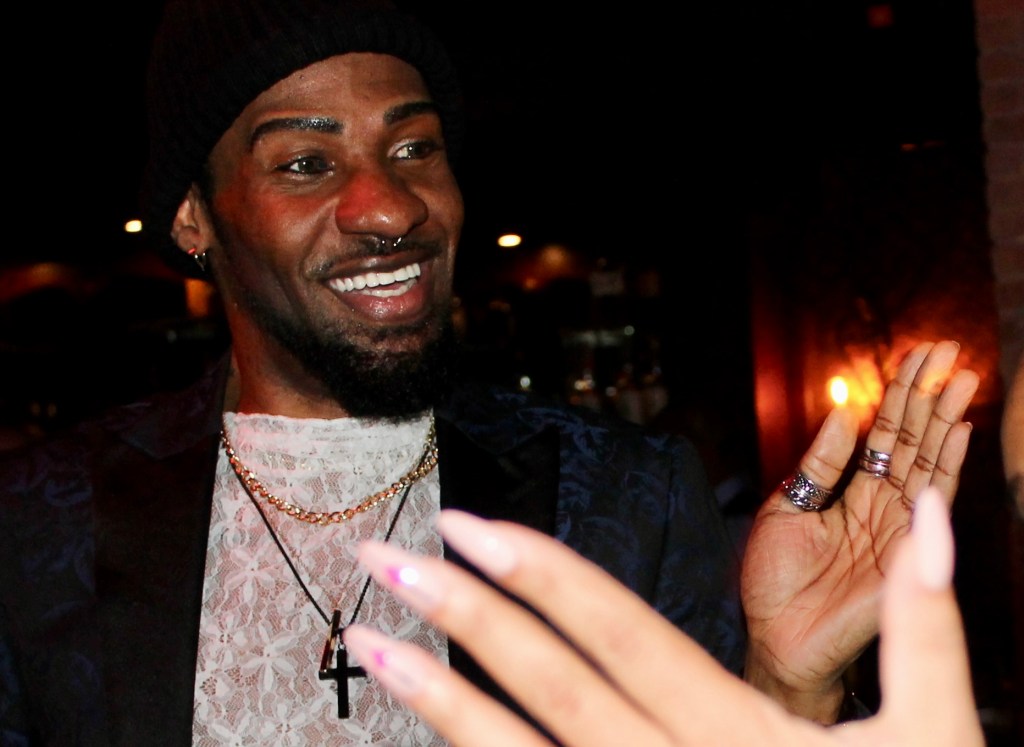
    Jahari Stamps (Photo by C. Schandelmeier, February 17, 2024)

    On a frigid, windy Saturday night in February, S@n!c Healing, heated up the stylish,  and exquisite venue at Grapes and Grains (also known as G&G) with an exuberant and exhilarating performance to a packed room of delighted guests. The band on the evening of February 17, 2024 was a talented trio consisting of Airius Reeves (saxophone), Hysien Govan, (piano and lead vocals) and Andrew Thomas (drums). Located at 858 West Lake Street, in the hot, happening area of the  West Loop, their repertoire was determined by the guests of the club whose song requests ranged from “I Would Die for You” by Prince to Taylor Swift’s “Love Story”, and Stevie Wonder’s “Superstition”  through Oasis’ “Wonderwall.”  Jahari Stamps, their talented lyricist and front man, normally performs with them, however, this evening, he said, “I just got done performing at the Willis Tower with the House Chi, I’m only here to watch my boys secure this room!” Because of his commitment, he arrived in time to support his band members. 

    Airius Reeves (saxophone), Andrew Thomas (drums) and Hysien Govan, (piano and lead vocals). (Photo by C. Schandelmeier, February 17, 2024).
    The band S@n!c Healing shouted out patrons celebrating their birthdays, including Julia, a tall brunette in a beautiful flowered dress. She and her crew added a liveliness and flair to the event.

    Jahari’s insightful and compelling song lyrics are what compelled this photo essay for Poetry in Chicago. In a sense, he did perform because he was there, at G & G, supporting his band, interacting with the crowd, taking photos, and dancing in his own unique and expressive style.  Jahari has reimagined life on earth through his interstellar lyrics, which include such titles as Intergalatic Soul Groove, and Moon Vibes. Jahari, is a true artist and poet whose work is tremendously newsworthy, however, his singing talent was not on display at G&G on Saturday night. Jahari is also a Superhero, because he has leaped over many obstacles (for example, drug addiction) on his path to becoming a popular performer in his own right. His song-writing is profound, and his showmanship is equally fascinating.

    Jahari Stamps, dances to the beat of the music at G&G where S@nic Healing performed on Saturday, February 17, 2024. (Photograph by C. Schandelmeier)

    Stamps began challenging traditional male stereotypes at a young age, as he started his artistic career as a dancer at a fine arts high school, and has gone on to become the singer and front man for his band, S@n!c Healing.

    Airius Reeves (saxophone), Jahari Stamps (center) Andrew Thomas (drums) delight in each other’s company during a brief intermission. (Photo by C. Schandelmeier, February 17, 2024).

    The unique way Stamps challenges gender norms,  his ability to turn a phrase, his political activism (he was an emcee for several events supporting Chicago’s new mayor, Brandon Johnson),  as well as his dancing all combine to liberate the spirit while supporting a new era of alternative music. As James Bennet and Niki Strange put it in their book Media Independence: Working with Freedom or Working for Free? “A key concept here is the relationship in everyday musical discourse, of independence as an institutional and organizational matter to more fundamental ideas of artistic freedom which are in turn related to the hugely complex and distorted notion of autonomy.”  Jahari’s artistic freedom is closely tied to his identity as a gay black man who does not need drugs to imagine a better world while supporting a candidate that is striving to make a difference (Brandon Johnson recently cast the deciding vote in the city of Chicago’s stand against the Isreali-Hamas war, for example)  through a complex and distorted system.

    Jahari Stamps dances with a customer at G&G on February 17, 2024. (Photo by C. Schandelmeier).

    These photographs from S@n!c Healing’s performance at G&G Saturday night are evidence of excellence in entertainment, service, and commUNITY. To reach Jahari Stamps or find out more about S@n!c Healing email: Jahari.stamps2015@gmail.com or follow the band on Instagram.

    Saxophonist, Airius Reeves performs for a member of the warmed up crowd.
    Piano player and lead vocalist Hysien Govan dons sunglasses for the performance “Superstitions” by Stevie Wonder. (Photo by C. Schandelmeier, February 17, 2024)
    Cecil from Grapes and Grains ensures the place runs like a well-oiled clock. (Photo by C. Schandelmeier, February 17, 2024)
    Charles said, “Thank you for coming! Have a nice evening!” G&G on Saturday, February 17, 2024.
    (Photo by C. Schandelmeier February 18, 2024)