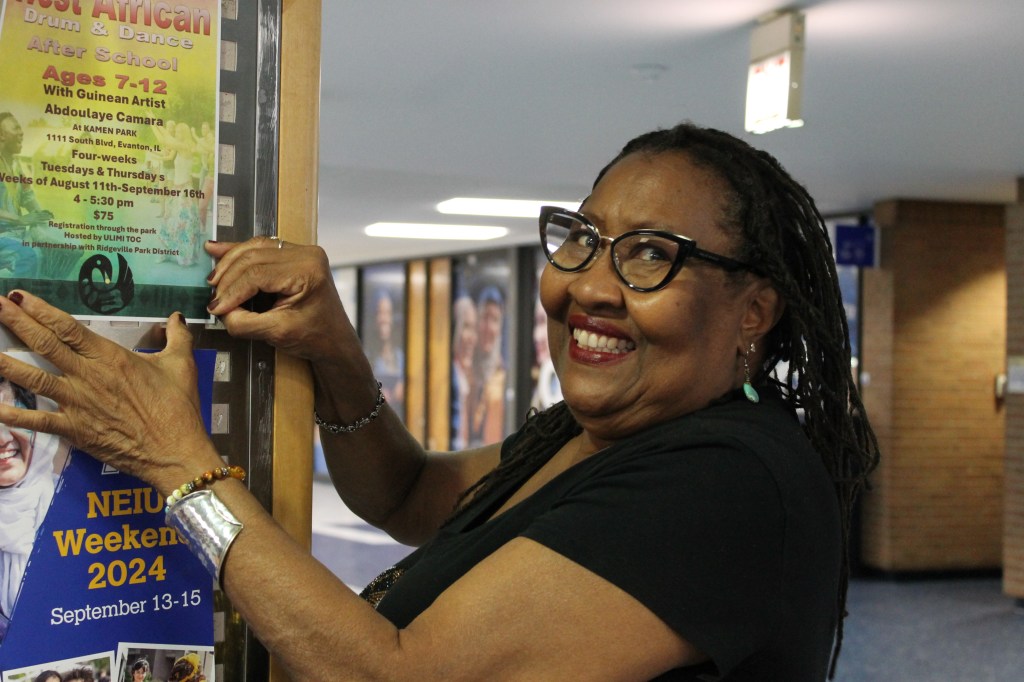
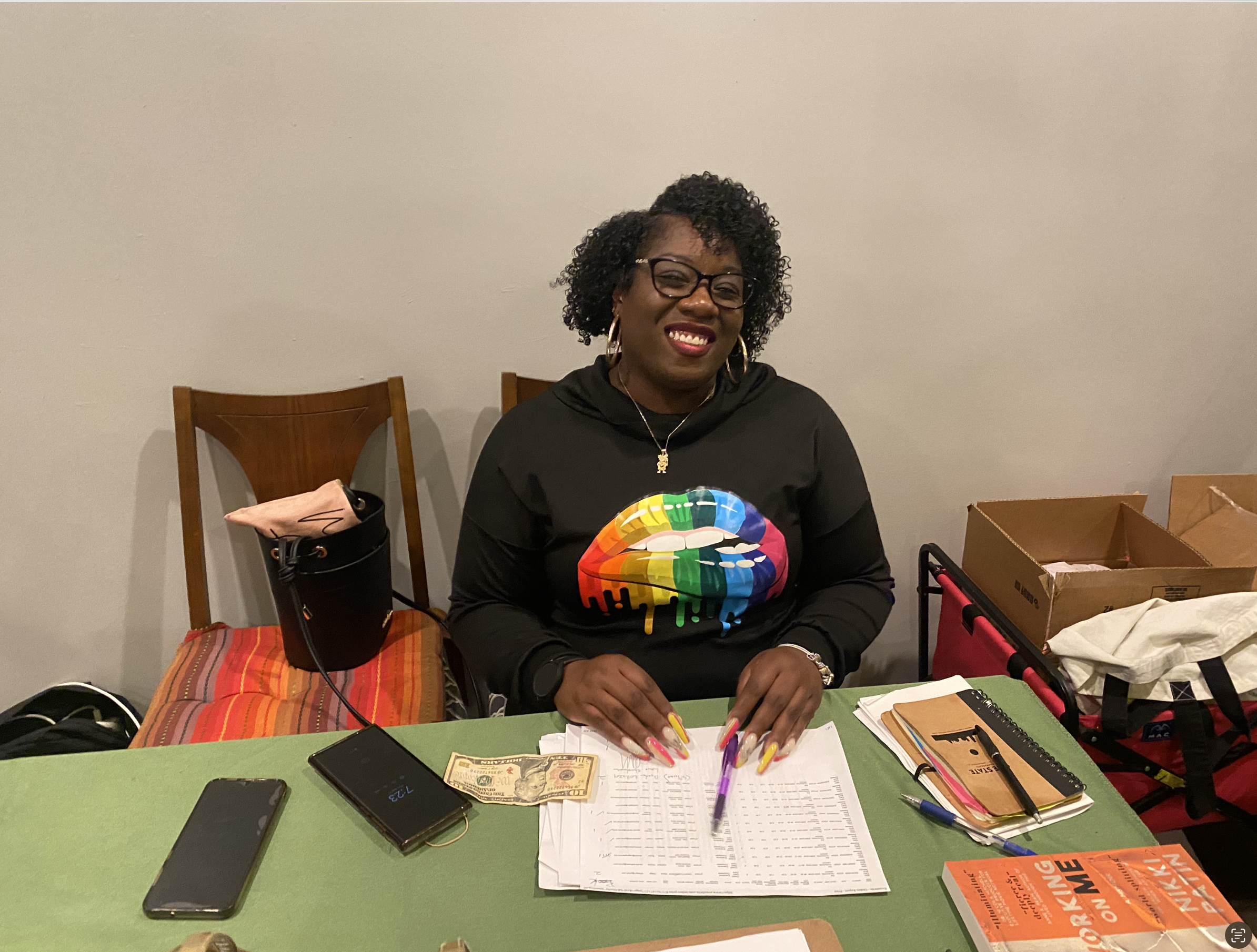
Esther Jones posts fliers for Ulimi TOC on the campus of Northeastern Illinois University, just before her WZRD Chicago 88.3 FM interview. (photo by C. Schandelmeier)
Esther Jones Creates Everything at Ulimi TOC
The soulful call of the African drum reached out and touched Esther Jones’ heart as she was driving home to Chicago from Evanston. She followed the call of the drum on a Monday night to Ridgeway Park where she met Guinean artist Abdoulaye Camara, an African performer, dancer and drummer. Camara now provides the heartbeat for the inaugural community workshop taught by Jones’ non-profit organization, Ulimi TOC. Here, children ages 7-12 years old learn about African culture, and language through drumming and dancing.
Ulimi TOC is a non-profit organization founded by Esther Jones in 2021, with the mission of educating the next generation about African culture and language. According to Jones, Ulimi is a Zulu word that means to speak, and TOC stands for tongue of culture. As a black woman in leadership, Jones is fostering artistic expression in the next generation, as Andrea Change is doing at the Guild Literary Complex. Jones’ aim in creating Ulimi TOC is to give African American children the opportunity to feel pride in their cultural roots. The workshops take place from 4-5:30 pm on Tuesdays and Thursdays at Kamen Park, 1111 South Boulevard in Evanston, Illinois from August 11th through September 16th.
Abdoulaye Camara is an African performer, dancer, and drummer from Ghana, West Africa. He is also the first instructor for Ulimi TOC’s workshop at Kamen Park in Evanston.
Abdoulaye Camara demonstrates an African gourd Kalimba Mbira thumb piano.
The David Wood Fieldhouse at Kamen Park is where Ulimi TOC, a 501-C3 non-profit created by Esther Jones to connect children with African American Culture.
The strength and clarity of Jones’ vision have proven vital to the reputation that Ulimi TOC is developing as a new nonprofit organization. Jones, a forceful artist in her own right, is a singer/songwriter, the author of the bookThe Poems of Esther, has an MBA and raised three children as a single mother in Chicago. She has much in common with Andrea Change, as a artist, single mother and executive director of a non-profit organization. The idea for Ulimi TOC came to her while she was working as a substitute teacher in a Spanish-speaking kindergarten class in Oak Park District 97.
“Not only were the children learning Spanish language, they were learning about the culture. I thought, there is so much more to African Americans than slavery. African culture is so rich. African American children need to learn about the language and culture of Africa.”
She said in an interview with WZRD on August 24th. Jones went on to explain how Ulimi TOC is designed to engage minds by connecting young African Americans with that culture. Her goal is to eliminate black on black crime by giving young people knowledge about the common bond they share.
Abdoulaye Camara, Amy Osterman and Esther Jones outside of Kamen Park in the David Wood Fieldhouse, 1111 South Blvd. in Evanston where Ulimi TOC sponsored their first workshop.
As her idea for the organization took root, Jones researched the closest African cultural and language studies program in the Chicagoland area, and discovered it at Michigan State University. So, she reached out to them with her idea, and has been collaborating with them ever since. She also partnered with Northwestern Illinois University’s Segal School of Design whose students are responsible for Ulimi’s new website and marketing materials. To find out more, visit the Ulimi website, email Ulimitoc@gmail.com or call (773) 410-6602.
Esther Jones alerts the musical community at NEIU about Ulimi TOC’s African drumming and dance classes just before her WZRD Chicago 88.3 FM interview on August 24, 2024. (photo by C. Schandelmeier)
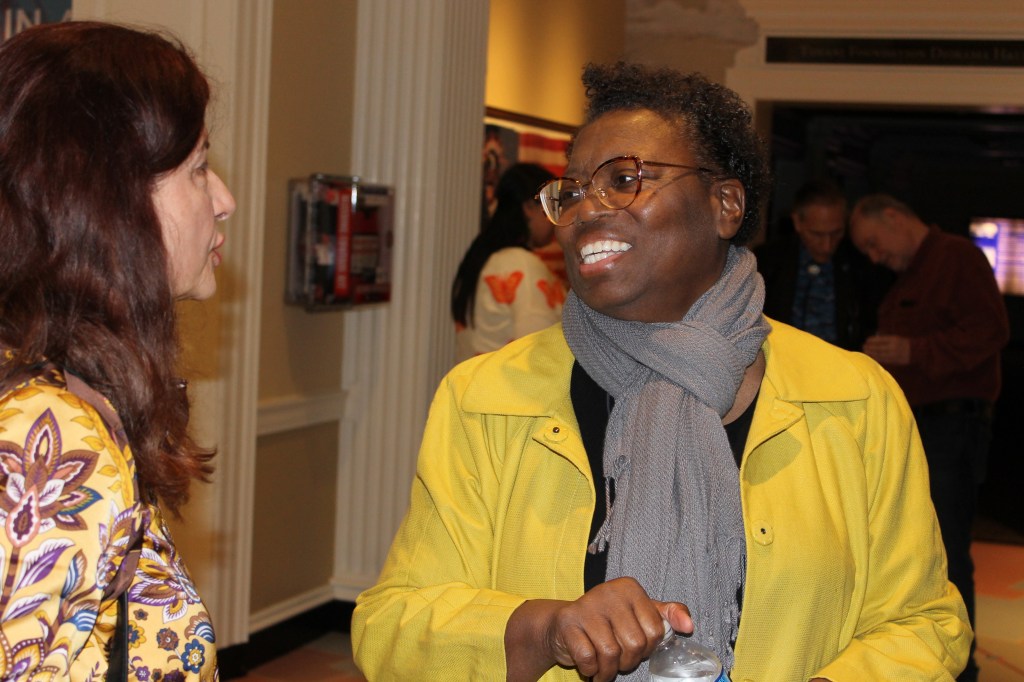
Cynthia Gallaher and Andrea Change chat after the Chicago Literary Hall of Fame Induction ceremony on April 16, 2024.
As the cork popped out of the bottle, a diverse group of happy humans gathered at the Honeycomb Network on April 11, 2024, and cheered with jubilation. The successful launch of Nikki Patin’s new book Working on Me is a testament to the visionary and transformational leadership that The Guild Literary Complex is experiencing through the one and only Andrea Change.
Executive Director Andrea Change brought a group representing the Guild’s diverse arts community out of the country to Bogota and Quibdó in Colombia with financial support from The Poetry Foundation. In order to do this, Change initially worked with Christian Vasquez, a graduate student from Northwestern University, and cultivated a relationship with Velia Vidal an artist in El Chocó, Columbia.
According to Founding Executive Director Michael Warr, (whose archives provided documentation), in 1993-1994, the Guild Literary Complex did an international exchange program with artists from the Goethe Institute in Berlin, Germany. According to Change, a group of poets representing the Guild Literary Complex also traveled to Norway when the Guild had former Executive Director John Rich at the helm. Nonetheless, through her work, Change is creating a legacy that sets the foundation for other black women in leadership roles, because never before has the Guild Literary Complex gone out of the country to work with people who have had such similar ancestral roots as they do in Quibdó, a city which is located in an isolated region of Columbia known as El Chocó. Change spoke in a March 9, 2024 interview with WZRD Chicago 88.3 FM;
“One of the reasons we were asked to come down there was because Quibdó is an underrepresented community. It’s mostly Afro-Latin, so instead of mostly white-facing Latin folks, this is the black-facing or people of color of Latin descent in that community. They really wanted us to bring folks who look like them to this community. So, all of the writers who are going are of Latin descent. They have brown skin, they have curly hair like me. It will extend the Guild’s mission to another part of the world, but it is still the Guild’s mission to be with underrepresented marginalized groups, and so, this is a city, but it is a small city, and it is a small community. But to be there, and be representing Spanish culture to people who look like us, or who look like me, is a privilege.”
Born and raised in Chicago, Change has been active in the Chicago literary scene, specifically the poetry scene for over 30 years. She knows the sacrifice involved with being a single mother, and the hardships of being the lone head of household in the city. Change described her process to becoming executive director of the Guild Literary Complex where she began as a poet and audience member, then was a volunteer, and eventually, served as an officer on the board of the Guild Literary Complex. The Guild Complex initially began as a brick-and-mortar bookstore under the leadership of Founding Executive Director Michael Warr.
Founding Executive Director of the Guild Literary Complex, Michael Warr in Clarion Alley, San Francisco. (Photo by Patricia Zamora, used with permission.)
According to Warr, the Guild Complex began as a bookstore, and had a reputation for being a gathering place for artistic souls that long encouraged cross-cultural collaboration. Warr is a former BBC reporter, published poet of WE ARE ALL THE BLACK BOY (1991 ), and Armageddon of Funk (2011), and both published by Tia Chucha Press and editedOf Poetry & Protest: From Emmett Till to Trayvon Martin, published by W. W. Norton & Company in 2016. While Warr has experience running the Guild Literary Complex as an executive director, talent agent, performance artist and poet Naiya Davis (aka Clou9aiya), whose Ted Talk Ouch…Did You Really Mean That? drives home the impact of microaggressions, is like Change, a black woman in leadership. During a June 29, 2024, interview with WZRD Chicago 88.3 FM, Davis said:
“When some people find out I am a leader, they look at me funny.”
Naiya Davis is a talent agent, spoken word artist, and poet. (Photo by C. Schandelmeier).
According to a recent Pew Research report, women are behind men in holding leadership positions. However, if Change has had this issue, it doesn’t show. As Mary Hawley, who was part of the Colombia expedition with the Guild Literary Complex and is also a Palabra Pura volunteer, stated “Andrea is humble.” Professor of English Literature at City Colleges of Chicago, Lynn Fitzgerald discussed Change’s leadership at the Guild Literary Complex during a July 6, 2024, WZRD interview:
“Andrea Change has been an instrumental cornerstone in the city of Chicago…she is also a woman of color, she is again, a woman! Women have to make their way in this world of art… Andrea has been instrumental in getting people out in the public eye and getting it known that these people have a voice, which is excellent…She takes more of a behind-the-scenes role, but I don’t think the Guild would be the Guild without her! She is so necessary, she is intuitive, and understands people very very well.”
Change’s acute understanding of marginalized people came through during a March 9, 2024, interview when Change was at WZRD, a week before her historic leadership role in taking the Guild Literary Complex and its representatives on their international odyssey. She described the Guild Literary Complex, which is historically a grassroots organization known for collaborating with other community groups on social and restorative justice issues in the city of Chicago in this way:
The Guild Literary Complex’s Executive Director, Andrea Change, networking after Patricia Smith was honored with the Fuller Award from the Chicago Literary Hall of Fame at the Poetry Foundation on July 11, 2024.
“Grassroots is a nice stamp, but this year we just celebrated our 35th anniversary…grassroots just refers to how we operate in the sense that we like to stay in touch with the community, which is challenging, I’ll say because Chicago is a really big city!”
Now, with Change, who is a gifted poet in her own right, as the Executive Director and support from the Poetry Foundation, the Guild is boldly stepping outside of location-specific arts programming to embrace national and international partnerships. The Guild provides arts and advocacy programming for marginalized voices, specifically black and brown people, including persons with disabilities, those who are incarcerated, and those identifying as LBGTQIA+. Terry Lonaric, poet, author, and journalist said,
“I like the way the Guild partners with community organizations to raise issues of social justice. When the arts become a part of community life, they reach their true potential.”
As Executive Director of the Guild Literary Complex, Andrea Change is helping diverse people reach their potential while creating pioneering and innovative forms of art. Historically, the Guild Literary Complex initiated the National Poetry Video Festival. It also was recognized by the 2022 New City “Lit 50” Awards under the leadership of Andrea Change. It has sponsored poets like Aviya Kushner, author of Wolf Lamb Bomb whose work was hailed as “noteworthy” by the New York Times in 2021. Change had been a long-time supporter of the Guild Literary Complex when she suddenly found herself cast into the role of volunteer at an event, according to Warr (who now lives in San Francisco) as he recalled in a podcast created from a virtual radio broadcast on May 5, 2024 with WZRD Chicago 88.3 FM.
Founding Executive Director of the Guild Literary Complex, Michael Warr discussed the history of the Guild Literary Complex and how Andrea Change first became involved with the 501-3C not-for-profit organization founded in 1989.
Susana Sandoval remembers when Andrea Change took the first step in her evolution from poet and audience member to volunteer. Susana, who, for the last seven years has been a human rights commissioner within the United Nations Permanent Forum on Indigenous Issues, is a journalist by training and was employed by the Guild Literary Complex as one of its two staff members, (along with Jen Abrams) under the leadership of Michael Warr in the mid-nineties.
In a virtual interview on July 6, 2024 from Ecuador, she explained that the Guild Literary Complex was a meeting place not only for academics, but for young lovers. She pointed out how she met Kahil El’Zabar, her former husband, and the father of her children at Guild Literary Complex. She also noted that the Lansanas, (Quraysh Ali Lansana and his wife, the poet and community builder Emily Hooper Lansana) met at the Guild as well. The Guild Literary Complex by all accounts was a safe place where artists and academics of any cultural background could go and feel accepted. Andrea Change, a single mother of Phillip, (who is now grown and living with his fiancé in St. Louis) was among them.
“But I don’t look my age!” laughs Change, “…This was one of those things where, and I tell this to people all of the time. ‘I am the executive director, but I like to say that I am sort of an accidental tourist. The work that I have done in the past was laying the foundation for the work that I do now.’”
The Guild Literary Complex is perhaps most well known in the literary community for their annual Brooks Day event honoring renowned poet Gwendolyn Brooks. In 1950, Brooks became the first African American to win a Pulitzer Prize. In a fitting example of symmetry, Change noted how poet Tyehimba Jess, still claims the Brooks prize in his biography, although like Brooks, he has gone on to win a Pulitzer Prize for his 2016 book Olio.
According to Change, this year the Guild will break from their usual tradition of celebrating Gwendolyn Brooks on June 7th, which is her birthday, instead celebrating Brooksday in October, 2024. The literary tradition of Brooksday is well documented, for example in this article by the Visualist.
Validating the Guild Literary Complex and their decision to present their annual Brooksday event in October, Professor Fitzgerald noted,
“October is Artists’ Month, and I remember working on Chicago Calling with Dan Godston and number of other people, we would have artists who were Zoomed in – this was before Zoom became some hot topic word – and we were connected on a stream in a Cafe or a Bar from other parts pf the world. So all of October was dedicated to artists. Galleries were just breaking apart at the seams with events! I don’t know if the Guild will resurrect some of that – they probably can because they have such international interactions with people. It is quite possible that they will. October will be a good month for the Gwendolyn Brooks event.”
The Guild Literary Complex embraces the non-binary community through its Press Room Transvengence series, hosted by trans artist Joss Barton. Barton explained during an interview with WZRD on April 30, 2024 how her disco-drag performance at a social justice fair hosted by Exhibit B led to her eventually being recruited by Change to host the series:
Joss Barton dreams of writing a nature collection, based on her experiences growing up in rural Missouri. Here, Joss is on the campus of Northeastern Illinois University, home of WZRD Chicago 88.3 FM. (Photo by C. Schandelmeier)
“I did this piece…performing disco-drag numbers in between spoken word for the Social Justice Fair – so when Andrea, the Executive Director of the Guild Literary Complex – was in the audience and she saw me do that body of work, she really really enjoyed it! She introduced herself to me after the show, and kind of just pitched the idea of doing something for trans writers with the Guild, and wanted to see if I had any ideas. So, I said ‘Let me think about it.’ So I pitched her the idea of Transvengence.” Barton continued, “Our art can be vengeance. You can take away our rights, but you can’t take away our stories.”
She flashed her dark eyes, flipped her hair, and stood strong in her identity as a trans woman, artist, and storyteller.
Joss Barton prepares to leave WZRD after her interview in April. (Photo by C. Schandelmeier)
Andrea Change introduces Transvengence featuring the work of Joss Barton, Jack, and Lynzo Heartthrob on June 18, 2024. (Photograph and videography by C. Schandelmeier)
On June 16, 2024, Transvengence featured Joss Barton (far left), Jack (on the mic), and Lynzo Heartthrob in an honest, candid conversation after the performance. The show is supported by the Guild Literary Complex Press Room Series. (Photo by C. Schandelmeier)
Change worked with Lansana to promote his 2024 book, Killing the Negative: Poetic Interventions, which he created with artist Joel Daniel Phillips. She explained how Phillips reached out to Lansana after he had discovered the depression-era film negatives of people archived at the Library of Congress with a single hole punched in each that was a destructive act known as “killing the negative” which served as the inspiration for the book. Such innovation through the lens of diversity is not new to Change. In the same interview, Change commented:
“Because of the nature of what we’ve done, we’ve had a strong connection to the poetry community, the African-American community, and other groups. Interestingly enough, we have always had a person of color either in a leadership role or on our board. We have always had someone who represented the LGBTQ community on our board, and someone of Latin descent on our board. It’s been a part of who we are. It is strange when I hear about people’s other boards…for me, it was always the norm to have a culturally diverse group of people who I have worked with.”
The Puerto Rican flag sculptures along Paseo Boricua in Humboldt Park signals Palabra Pura poets and audience members that their destination of La Bruquena. 2726 W Division St, Chicago, IL is near. (Photo by C. Schandelmeier, July 17, 2024).
Change brought transformation to the Guild Literary Complex through the Guild’s recent trip to Bogota and Quibdó, Colombia where they worked with MoTeTe. Change and other members of the Guild Literary Complex such as Mary Hawley (Palabra Pura volunteer and translator) and Hawley’s husband, poet Mike Puican (former board president for the Guild Literary Complex) traveled with a delegation of Spanish speaking black and brown writers (thanks to a grant provided by the Poetry Foundation) in order to interact with their South American artistic peers.
Poet Elizabeth Marino, author of Debris and poet Shontay Luna author of Reflections of a Project Girl, both participated in the One Poet: One Poem event held July 17. 2024 by the Guild Literary Complex’s Palabra Pura series hosted by Gregorio Gomez at a Bruquena. 2726 W Division St, Chicago, IL. (Photo by C. Schandelmeier)
The Guild Literary Complex representatives did this all while writing, learning, and exploring an environment which echoed their own diversity and linguistic roots. The group of American artists, led by Change, included Kianny N. Antigua and Luis Tubens among others. Followed by a documentary crew, this was the first international experience for The Guild Literary Complex. The release of the documentary based on this epic journey is slated for October, 2024.
Mary Hawley is a translator and long-time Palabra Pura volunteer for the Guild Literary Complex. (Photo by C. Schandelmeier)
Poet Mary Hawley is the translator and long-time volunteer of the Guild Literary Complex’s Palabra Pura series who joined the Guild Literary Complex on their epic adventure to Colombia. Hawley spoke to WZRD Chicago 88.3 FM in an April 27, 2024 interview about the once-in-a-lifetime experience after the journey. She explained how , Vásquez (originally from Colombia) became involved with The Guild Literary Complex, and then introduced Vidal to the organization when she participated in a virtual reading for Palabra Pura during the COVID-19 lockdown.
Because of this professional association through the spoken word, the group went to an annual literary festival in a region of Colombia called El Choco’. The festival, which has officially been in existence for 7 years, is known as FLECHO (so-called because of its initials) and was created thanks to the leadership of Velia Vidal. As Hawley explained,
“When they were organizing this year’s festival, Andrea Change, who is the Executive Director of the Guild Complex, was able to get grant money to send an international delegation of poets from Chicago and the US to this literary festival in El Choco’ with a particular focus on the African diaspora. So our group included Kianny Antigua, who is a poet, novelist, and translator from the Dominican Republic. She teaches at Dartmouth. Luis Tubens otherwise known as ‘Loco Lu’ from Puerto Rico who is here from Logan Square and a few other participants who went with us. We were there for a week.”
James Stewart III is the author of “Defiant Acts” being published by Acre Books out of the University of Cincinnati in 2025. He is also the president of the board of directors at the Guild Literary Complex, and co-founded Exhibit B.
James Stewart III, the President of the Board at The Guild spoke to WZRD Chicago 88.3 FM on July 20, 2024 about Exhibit B, the literary variety show he co-founded. He explained how they had reached out to Andrea Change for support through the Guild Literary Complex. Change welcomed Exhibit B and their innovative ideas (Exhibit B members came together as recent graduates of the Master of Fine Arts program at the School of the Art Institute). He noted that while the Guild pays a hundred dollars per gig at the most, it is more than the average because most people seem to think that artists can live off nothing. Change knows better than this.
True to her name, Change is concerned about preparing the next generation of leadership to take over the Guild Literary Complex, which continues to develop deep meaningful connections within a historically marginalized community. The fact that Change has had health issues increases the urgency of this work. Change is at the cutting edge of creating a difference in the world for all people. If only the rest of the world could pivot into this type of change. To find out more about the Guild Literary Complex go to: GuildComplex.org.
Alanis Zoe Castillo Caref and Emily Maciel are best friends who met in their high school poetry club. They also co-host a spoken word open mic in Wicker Park.
To connect with more like-minded people who support the role of literary women leaders like Andrea Change, visit the Facebook page:
Andrea Change reaches across the aisle in conversation with David Gecic, publisher of Puddin’head Press at the Chicago Literary Hall of Fame Induction Ceremony on April 18, 2024. (Photo by C. Schandelmeier)
The Vision of Poetry in Chicago is to be Chicago’s poetry news source.
Vision Video created by C. Schandelmeier
EVENTS
Poetry in Chicago provides poetry to Chicago through the Beach Poets, hosted by C. Schandelmeier since 1990.
Cathleen Schandelmeier, Nakiyah T. M. Jordan, Alanis Zoe Castillo, and Michael Dean are applauding silently for the July 21, 2024 Beach Poets experience. (Photo by Emilio Maldonado, used with permission).
PUBLICATIONS
We are accepting submissions for publication of our first Poetry in Chicago journal with the theme of Poetry to Free Gaza open to all perspectives on this issue. Call for submissions coming soon.
AWARDS
Poetry in Chicago is the sponsor of the Effie Awards for lifetime achievement in the arts. Nominate someone today at: poetryinchicago@gmail.com
The Life Celebration for Effie Mihopolous was organized by me, (Cathleen Schandelmeier, as Effie had requested) and featured poets Cornelius Eady, and David Hernandez as well as filmmaker Josephine Lipuma. The Trapdoor Theatre under the direction of Beata Pilch performed a scene in Effie’s memory. I closed with a poem that ends “When I die, I don’t want to rest in peace. I want to be ground into your souls, and dance…” Then, Ensemble Espanol Spanish Dance Theatre’s Youth Company danced her out.
NEWS
Please contact Poetry in Chicago via email with news for coverage. Email: Poetryinchicago@gmail.com
Poetry in Chicago places the common good above influences that are commercial, personal and political.
The goal of Poetry in Chicago is journalism that influences viewers, listeners and readers with the facts: what the audience believes or feels after learning about these facts is entirely up to them. When selecting what news to write, producing it, and delivering it, Poetry in Chicago is scrupulous during every step of the reporting undertaking, that includes selecting stories, gathering news, producing news, all the way through production and delivery.
Poetry in Chicago is a practitioner of ethical journalism that looks for a variety of opinions in order to achieve better results that provide incontrovertible evidence which are accurate and unbiased. Looking at the story from different angles and revising a story are also important attributes of Poetry in Chicago’s ethical journalism. Making informed decisions using writing, design, photography are attributes that evolve through research, industriousness, and discipline.
Therefore, Poetry in Chicago adheres to The RTDNA Code of Ethics. These ethics do not demand what a reporter must do in every quandary that they face, but give them the tools necessary to make better choices for the people and the communities which we serve.
Marc Kelly Smith is the originator of the Poetry Slam, an art form that encompasses the globe. (Photo by C. Schandelmeier, May 25, 2024).
The Uptown Poetry Cabaret from the Green Mill Tavern is making its way to Space at 1245 Chicago, in Evanston, IL. Marc Smith hosted his second poetry reading there on May 26, 2024. (Photo by C. Schandelmeier)
Space is the place for the Uptown Poetry Cabaret
Marc Kelly Smith filmed on location at WZRD Chicago 88.3 FM on May 25, 2024. (Video by C. Schandelmeier)
Envision a world where conflict is resolved through poetry, and whose creator celebrates what makes people come alive. This is the reality of life for Marc Kelly Smith (say his name, and he adds “So What?”) who is the founder and host of the Uptown Poetry Slam at the Green Mill Tavern. Hosted by Smith, it is the longest running show in the history of Chicago, and, while it was stopped during the COVID-19 lockdown, it is back up and running like a clock, on the second Sunday of each month. The doors open at 2:00 pm and the show begins at 3:00 pm. It is an incredibly popular event with standing room only. Many well-known spoken word artists from Chicago point to the beginning of their careers as happening at the Green Mill tavern under the watchful eye of Smith.
Fabrice Garcia-Carpintero, filmed this performance of Marc Smith while he was in Paris, France, in May, 2024. (YouTube Video used with permission).
While he has officially become a knight, “a chevalier” in France, where the poetry slam caught on with great fervor, and has traveled not just nationally, but internationally in the name of the poetry slam which he invented, Smith still identifies himself as a blue collar, working class guy who is humble and shy.
“I am an average student from the Southeast side of Chicago…I found my destiny. I never knew that I was going to be on the stage. The universe, if you open your eyes and heart will steer you in the right direction, so, I got steered in the right direction…and then I started writing love letters to Maria Elaina Rosa in high school. Then, it just kept going! I met my wife, Sandy at Western Illinois University and she loved poetry, so I started writing it – and kept on doing it ever since…”
Marc Smith comes alive when he is performing, as does the crowd who gets caught up in his exuberant energy. “I am a very good performer because I have been doing it for over 40 years.” He says with a sparkle of joy in his eyes. He continued,
“It’s kind of ironic that what the universities criticized in the late ‘80s and early 90’s is now taught. We just had a visiting Italian poet, Eleonora Fisko, from the University of Chicago, and her dissertation is on the poetry slam… I am a little leery of the institutionalization of the slam, and I don’t want it to turn into some academic exercise. It is more of a social activist thing than it is a university thing. But everything goes into the university because it is a study of culture.”
The academics who once found his work unappealing are now using the slam in textbooks. Smith’s work is being used the basis for doctoral dissertations for people such as Eleonora Fisko from Italy. She is the new coordinator of the Students Slam Championship, and is pursuing a PhD from both the University of L’Aquila and Lausanne (Switzerland). One academic, Terrance Jacobus, (1949-2023) had been an adjunct professor at Northeastern Illinois University, as well as a DJ for WZRD Chicago 88.3 FM in its punk rock days, helped inspire the form which evolved into the slam through what he called “bouts.” Smith recalled Jacobus’ work:
Terry Jacobus,he had been at WZRD, he was more in the punk scene which was big at that time. He was hanging out with Jerome Sala and a few more, I forget all their names but at first, he was kind of adversarial. We were young and bumping heads. He had a classic poem like “The Raven” he changed into his own style – Terry – and – the punk scene had started a competition, and we were rivals. They assumed it was this goofy competition that made things so popular at the Green Mill. But it wasn’t! It was the performance aspect! In fact, now, I don’t even do a serious competition at the show. There is technique to performance, and that is what made things so strong. The competition that we started at the Green Mill – it was just the last set of the show, and I kept doing it because it is like a theatrical device. It focuses everyone’s attention. It is a downfall because – no one wants the arrogance that they see when everyone is trying to write and perform just to get the money in the pot. That is something I regret about the slam….I just started doing a podcast with the original history of it. Like what Wendell Barry said “poetry is not to glorify the poet, it is to celebrate the community around the poet.’ That is one of the principles I adopted in forming the slams over the years.”
Emily Calvo, a well-known poet and artist, worked with Smith to create the idea of doing performances in two languages, bringing together people across the linguistic divide, through the Speak’Easy Ensemble which creates the One Poetic Voice performance interpretation. “So many people say that they discovered the something that had been missing from their lives with poetry through my work at the Green Mill.” He said.
When asked about his legacy, he responds that his hope is that great artists will be able to point to his work as the place where it all began because, “I consider performance sacred. That is what the slam is, combining the art of poetry with the art of performing. It has changed people’s lives, truly, it has set them on a direction…there are hundreds of stories about people who came together and created poetry, but it became a saving time for me. It is an art form that makes people come alive!” In this way, the poetry slam helps people realize their hopes for a better world, and better lives. May the rest of the world catch up sometime soon.
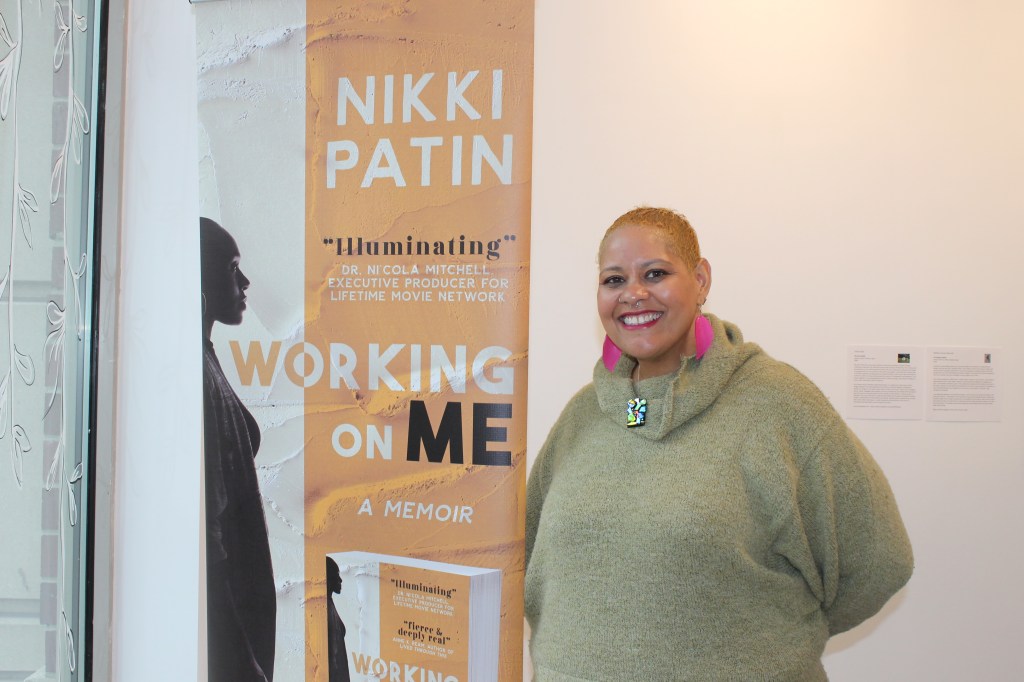
Nikki Patin released her book on April 11, 2024 at the Honeycomb Network and the help of the Guild Literary Complex, and Andrea Change.
The Honeycomb Network was buzzing with activity and an aura of excitement as the book release party got underway for Working on Me by Nikki Patin at 2659 W. Diversey in Chicago on April 11, 2024. The book was honored with an official release party organized by The Guild Literary Complex under the leadership of Andrea Change. Change, being true to her name, has taken The Guild Literary Complex from being a small, grassroots literary organization dedicated to social and restorative justice for black and brown people through performance events to being renowned both nationally and internationally, with a recent trip to create art with a like-minded community in Quibdó, Colombia, South America. The Guild Literary Complex worked with author Nikki Patin to have her first book, Working on Me, a memoir in the genre of creative non-fiction released during sexual assault awareness month. Published by Vine Leaves Press in Greece, this dramatic memoir deals with sexual violence issues head on, and pulls no punches as it grapples with three generations of the same family through unique voices and strong writing.
According to Andrea Change, “Nikki’s work as an advocate for sexual assault awareness works because she is a survivor and her background as a literary artist combined with her emotional intelligence creates a safe space for the other survivors in her circle.”
A 45 year old single, queer mother, Patin is courageously creative. She has written this book from the depths of her soul, providing details behind family stories and building them up with resonate details, as only an accomplished writer can do. Her dedication to innovation and revolution that bucks the patriarchy and rebukes the mainstream can be seen in her decision to promote the book using a series of music videos with narration from the book as inspiration.
Her first video, Brickcan be found on Youtube. It is clearly the work of an artist dedicated to thoughtful reflection on difficult topics. Brick uses strong visual imagery at its core, the music video really makes the work come alive in Patin’s world, where fragments of the brick fly back to it, recreating its original form. Her unique editing skills are a sleight of hand that renders a magical place where bricks can restore themselves after injury. Of course, the analogy belies the fact that bricks cannot restore themselves, though human beings are capable of healing at a fundamental level, trauma undoubtedly causes them to change.
As Patin said in an April 20, 2024 interview at Woman Made Gallery, located at 1332 S. Halsted in Chicago, “I like to co-power with people. I don’t like to empower people. I believe that people are already powerful, and I’d just like to recognize that. I do what I can to help people in bringing out their own personal power.”
Patin has not been granted the same solicitude in her life where she endured unimaginable horrors as the victim of sexual violence. As a result, Patin has spoken with the United Nations about the impact of rape on black and brown women in the United States, performed on HBO’s Def Poetry Jam, and advocated for the rights of residents in Englewood through her work with RAGE. To find out more about Nikki Patin and her book, visit her web sitewww.NikkiPatin.org
Nikki Patin, author of “Working on Me” published by Vine Leaves Press out of Greece, had their book release party given by the Guild Literary Project under the leadership of Andrea Change on April 11, 2024 at the Honeycomb Network. (Photo by C. Schandelmeier).
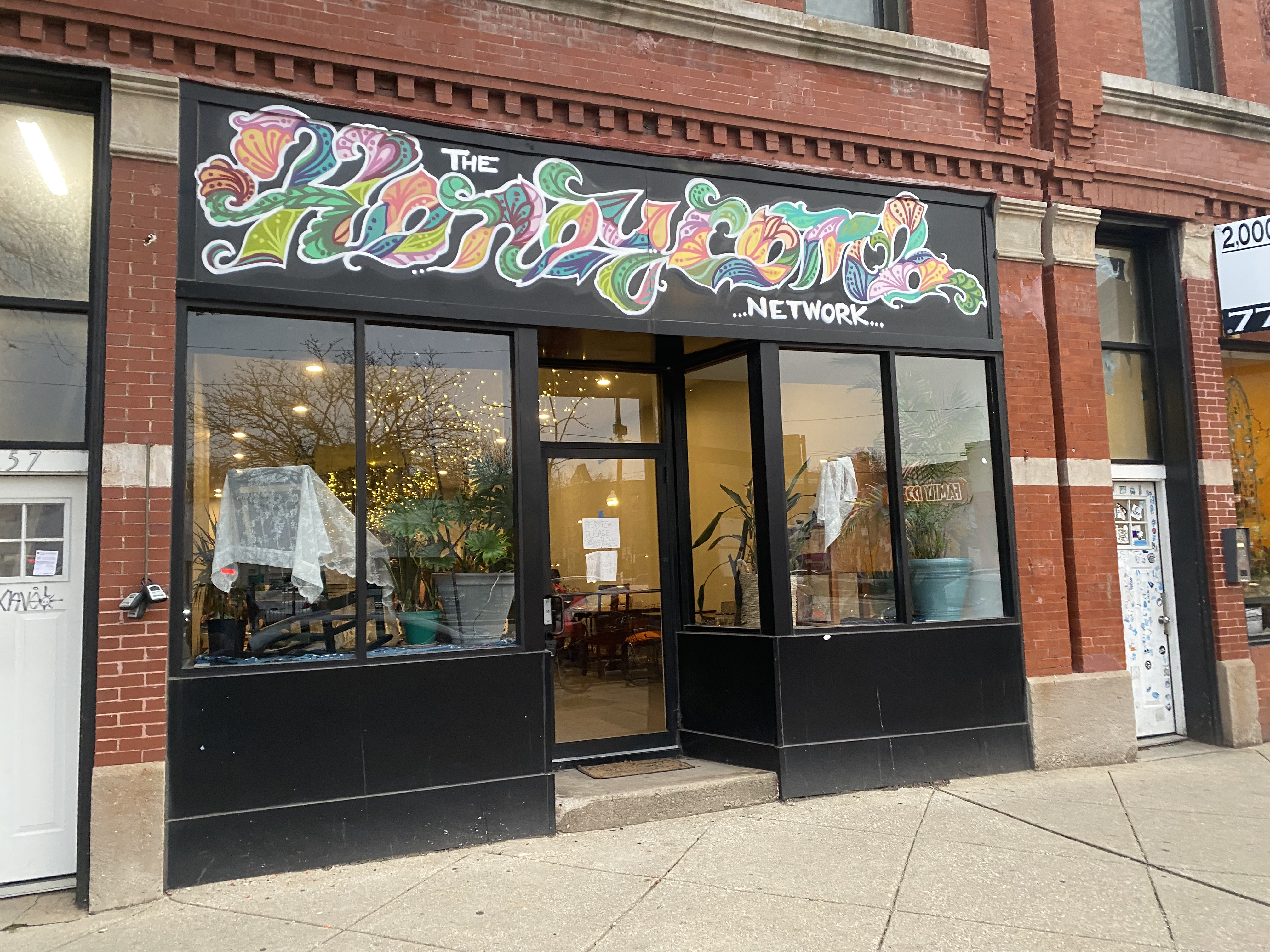
True to Patin’s spirit of advocacy as a trauma survivor, her book release party was held at The Honeycomb Network at 2659 W. Division Chicago, Illinois. It is known for being a community space offering holistic co-working, co-creating plus collective care services. The physical and online location contain a boutique apothecary gift shop, workshops and cultural events lead by a BIPOC network of healers, educators, artists and holistic service providers. (Photo by C. Schandelmeier)
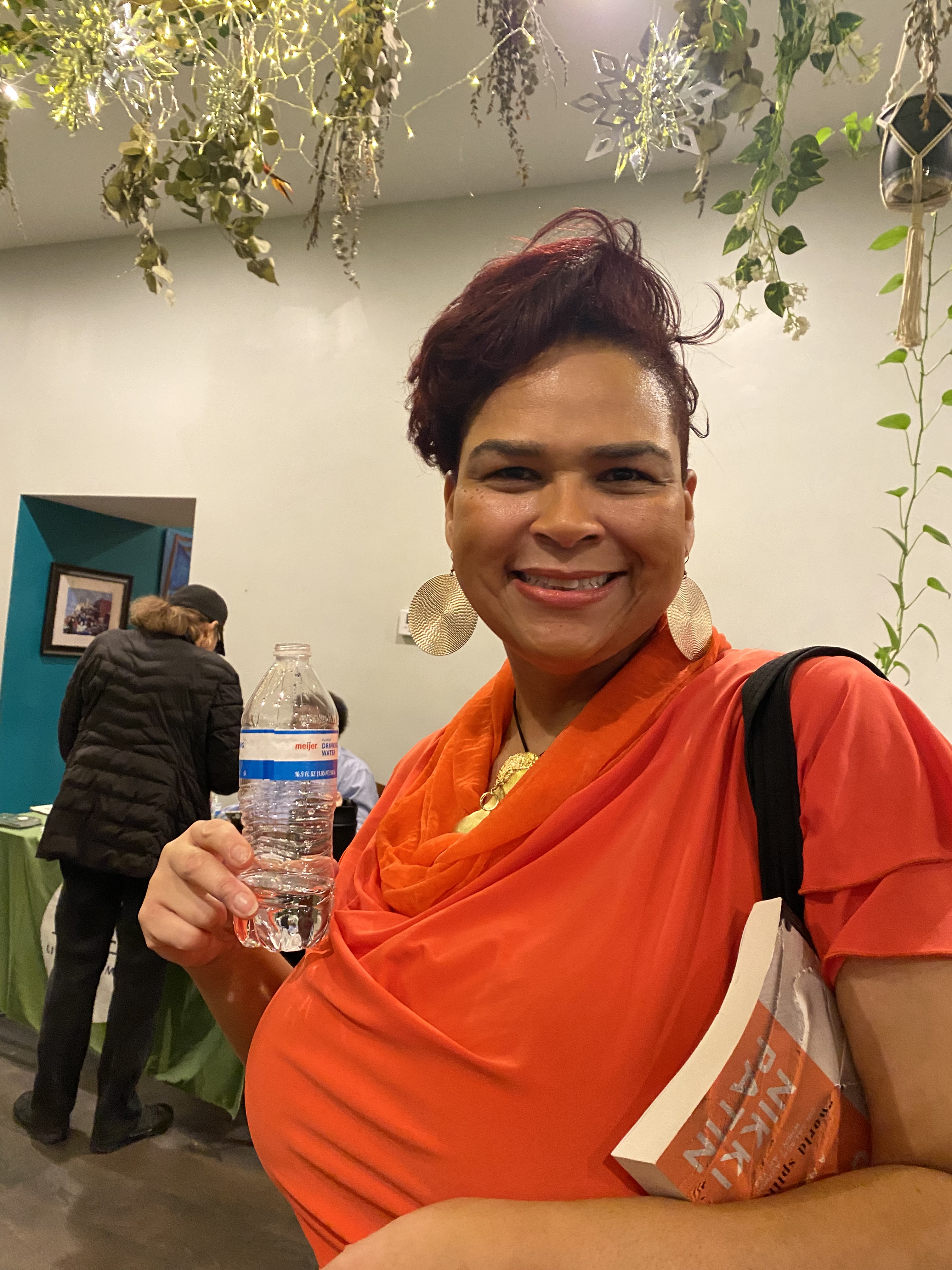
Clutching Nikki Patin’s new book firmly under her arm, Sonja Wilson is one of the people who came out to be one of the first to get Nikki Patin’s new book “Working on Me.” (Photo by C. Schandlemeier)
Executive Director of the Guild Literary Complex, Andrea Change introduces Nikki Patin’s new book “Working on Me” at the Honeycomb Network on April 11, 2024. (Photo by C. Schandelmeier)
Kao Ra Zen (Rapper/Poet/Musician and Performance Artist) is the Programming Associate for the Guild Literary Complex. (Photo by C. Schandelmeier)
Sainte Harden-Tate is part of Surviving the Mic, a performance group that Patin founded to to give voice to sexual violence survivors. To find out more, go to https://survivingthemic.org/ (Photo by C. Schandelmeier)
Creating Weeds Tavern: Poster Art and Singing with the Jazz Lizards
Weeds are generally something to be avoided, however, the tavern known as Weeds was a place where art bloomed under the careful nurturing of a humble man known as Sergio Mayora. Wearing overalls and sunglasses, under a rain forest of brassieres surrounded by funky dumpster dive finds, Mayora fueled customers with shots of tequila, poetry (hosted for over 20 years by Gregorio Gomez), music, and late night soirees. In the days before social media, Mayora beaconed new clients inside of Weeds with brilliant posters he created from collage. This was how he advertised the tavern where he worked as bartender and host.
The result was a comfortable, bohemian-style environment that encouraged free thinking and creativity. In his book Weeds Tavern: Poster Art,Mayora created colorful psychedelic advertisements for this historic time. He also can carry a tune. Audience members will be able to experience the legendary creative force that is Sergio Mayora first hand as he sings with the Jazz Lizards, April 4th at 7:30 pm when he performs at The Black Eagle, located at 1938 West Irving Park Road, where Mayora will most likely be performing a poem as well.
Weeds Tavern was famous for performances and poetry over 20 years. Poetry flowed freely every Monday night when it was hosted by Gregorio Gomez. Righteous Bob Rutnick started it, Marc Smith came in for a short time, but soon lost interest. It was Gomez, who, “At first,” according to Mayora, “He was terrible! But he grew into the role.” Gregorio has moved on to write books, and create music, as well as gracing the cover of photographer Diana Solis’ most recent book “Luz: Seeing the Space Between Us.” It is Mayora, however, who created posters to advertise Weeds.
He is not only famous for his poster art, Mayora is also famous for what he calls his “Spirit boxes.” Which he invented when his son was small. Mayora couldn’t afford a fancy gift with Christmas on the way. His son was playing with a wooden cigar box, drawing on it in crayon. Mayora was inspired to create his first Spirit box as a gift for his little boy. Subsequently, Mayora has had his work with Spirit boxes displayed in art galleries, and was commissioned to create work for such musical geniuses as Carlos Santana. “It was the Willie Dixon Foundation that commissioned me to make the Spirit Box for him.” Said Mayora. Willie Dixon was a guitarist, and wrote one of Santana’s favorite songs, so it is only natural that the Willie Dixon Foundation would want to do something special for Carlos Santana.
Mayora has a unique way of connecting with the world that needs to be cherished, and fondly remembered. He has thrived despite the fact he uses a flip phone and still does not use social media.
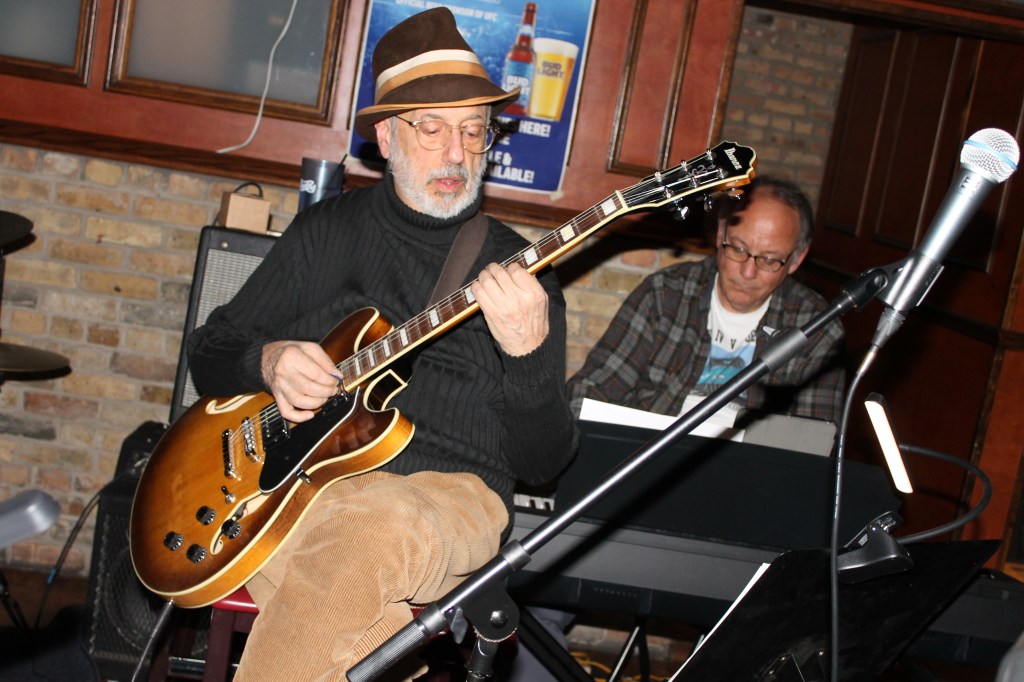
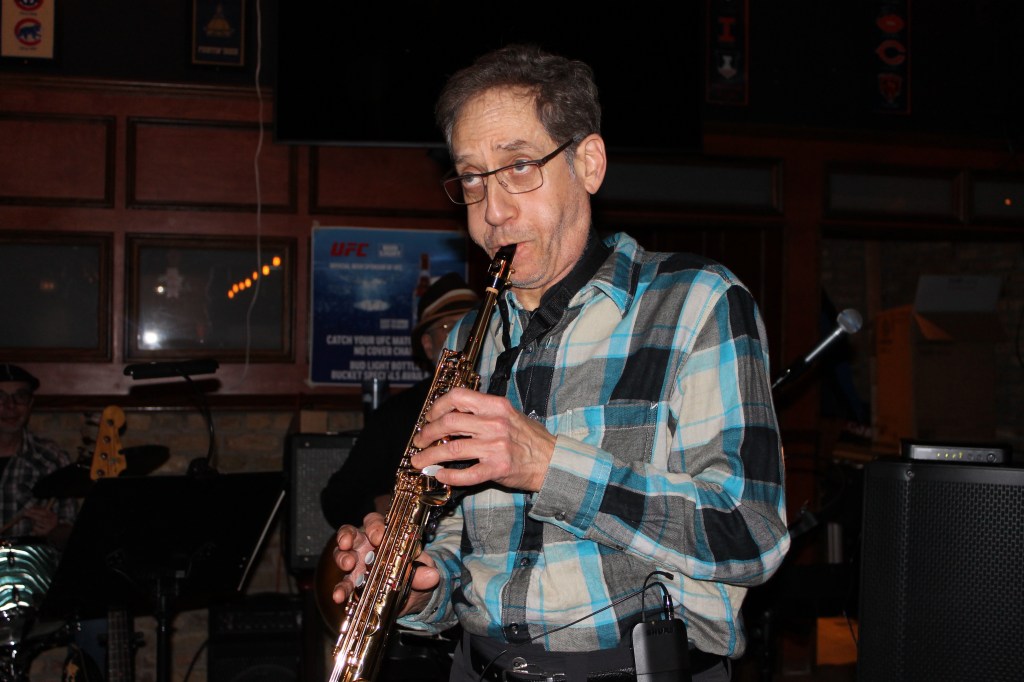
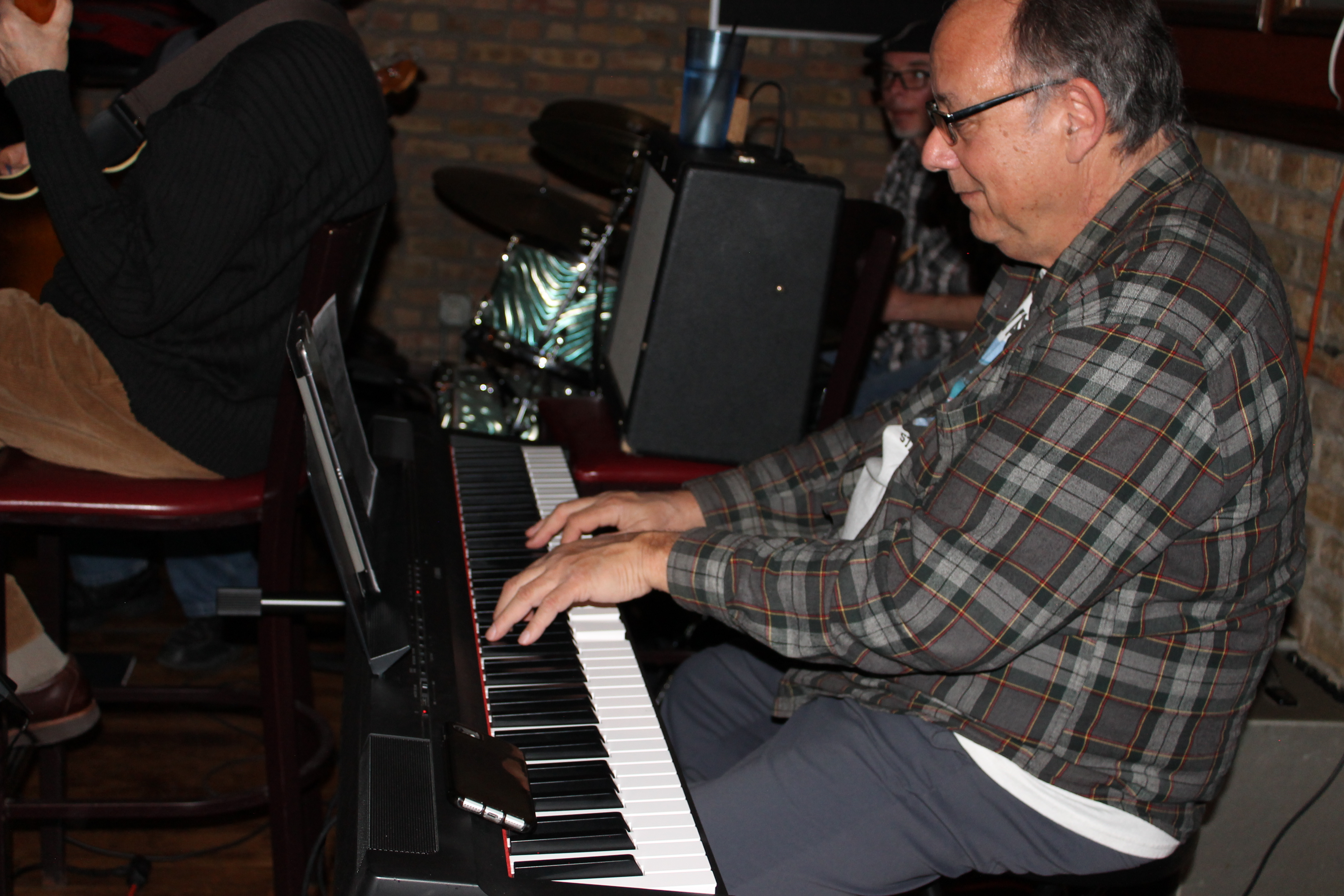
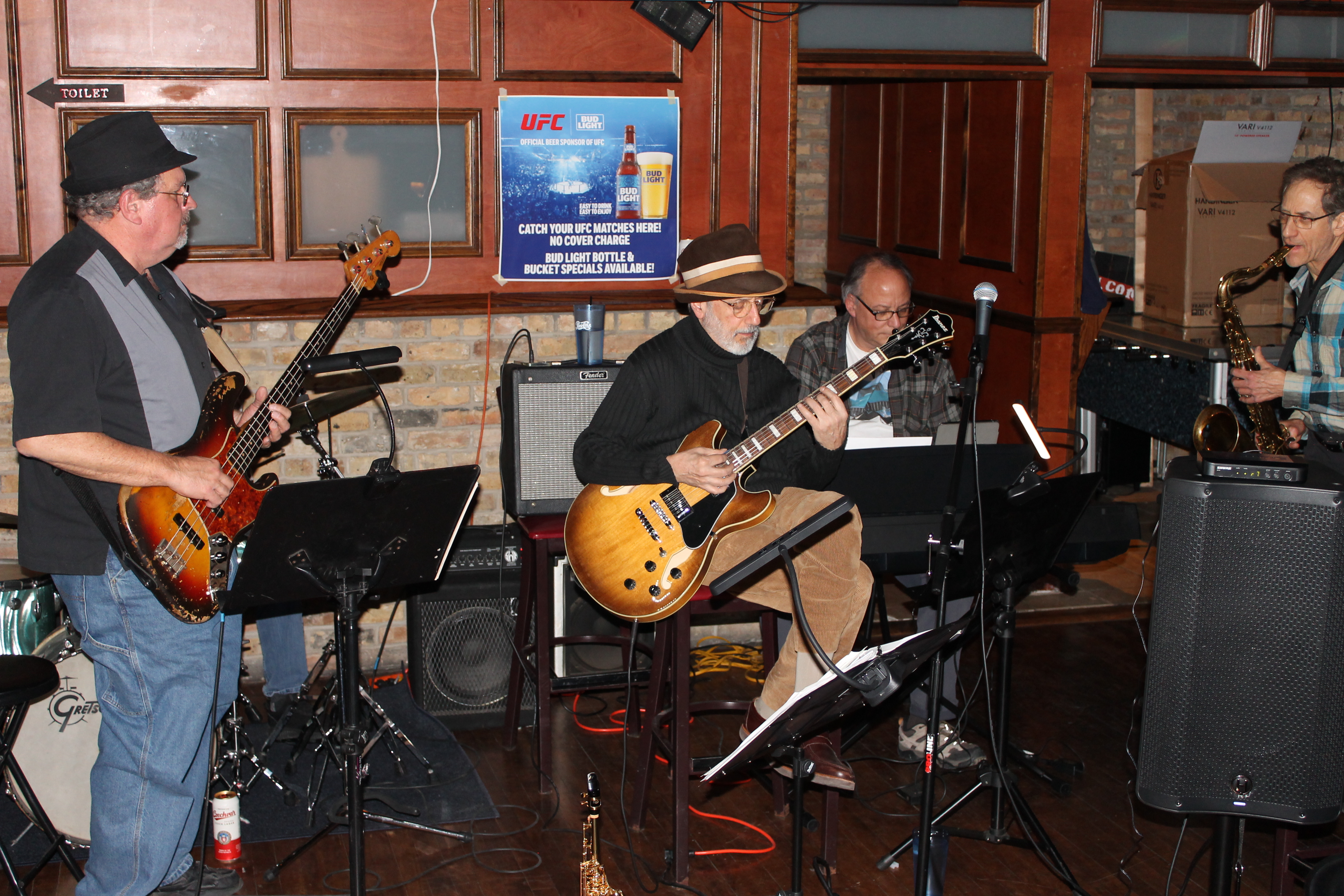
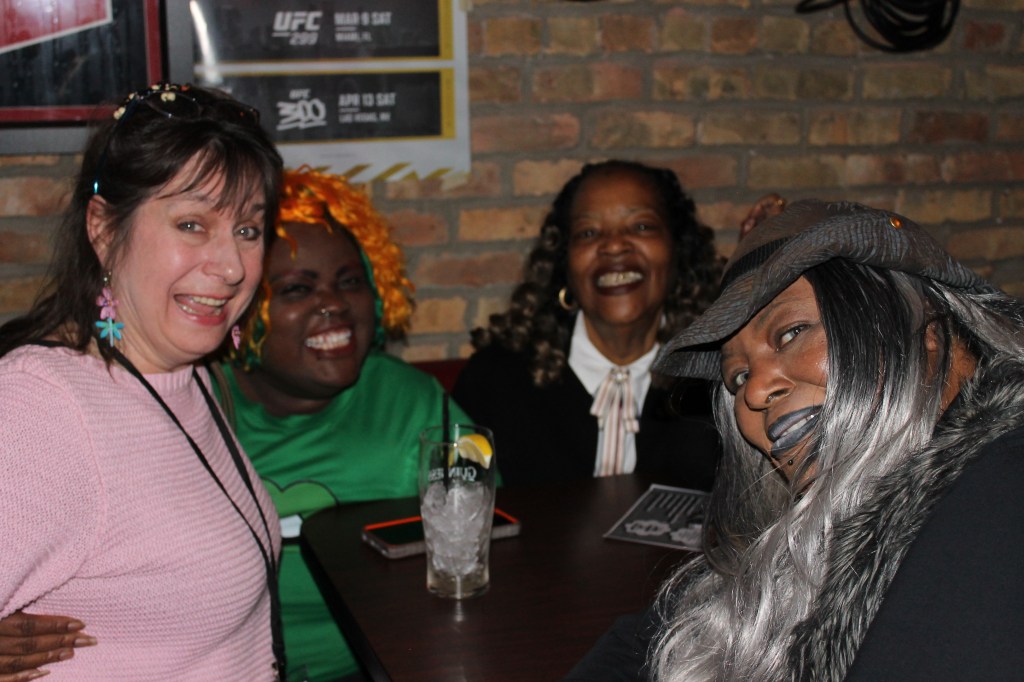
Sergio Mayora at the mic during poet Robert Edward’s (Edwards’ is a CPS teacher, CTU member, and active in the Coast Guard) monthly poetry reading at the Levee at 4035 W. Fullerton in Chicago.Sergio Mayora at the Black Eagle 1938 W. Irving Park Road in Chicago, where he performs with the Jazz Lizards, April 4th and 18th at 7:30 pm. No cover charge. (Photo by C. Schandelmeier)Sergio Mayora, at WZRD Chicago 88.3 FM on March 26, 2024. (Photo by C. Schandelmeier)Sergio Mayora during his interview at WZRD Chicago, 88.3 FM on March 26, 2024. (Photo by C. Schandelmeier)Mike Campbell and Sergio Mayora are great friends, seen here at WZRD Chicago, 88.3 FM. (Photo by C. Schandelmeier)Mike Campbell and Sergio Mayora at WZRD Chicago, 88.3 FM. (Photo by C. Schandelmeier)Jazz Lizards JimiJon on guitar, Mitch S. on keyboard at the Black Eagle, 1938 W. Irving Park Road on March 21, 2024. (Photo by C. Schandelmeier)Jazz Lizards band features the legendary Martin Baney on drums at the Black Eagle, 1938 W. Irving Park Road. (Photo by C. Schandelmeier)Jazz Lizards band features the legendary Martin Baney on drums at the Black Eagle, 1938 W. Irving Park Rd. (Photo by C. Schandelmeier)Jazz Lizards band features Jimijon on guitar. (Photo by C. Schandelmeier, March 21, 2024)Marco G. is the leader of the Jazz Lizards, performing at the Black Eagle. (Photo by C. Schandelmeier, March 21, 2024).Jazz Lizards band features Mitch S. on bass. (Photo by C. Schandelmeier, March 21, 2024).The Jazz Lizards features Martin Baney on drums. (Photo by C. Schandelmeier, March 21, 2024)Leader of the Jazz Lizards band is Marco G. on saxophone. (Photo by C. Schandelmeier, March 21, 2024)Trumpet and saxophone player Peter C. Bartels (who can be found busking regularly at Lincoln Park Zoo) relishes a rare opportunity to enjoy live music on the side of the audience. (Photo by C. Schandelmeier)Jazz Lizards band includes Sammy G. jamming on the keys. (Photo by C. Schandelmeier, March 21, 2024).Sammy G. enjoys playing on the keys at the Black Eagle on March 21, 2024 with the Jazz Lizards. (Photo by C. Schandelmeier)Jazz Lizards band: Marco G. on saxophone, Jimijon on guitar, Mitch S. on bass, and Sammy G. on keys. (Photo by C. Schandelmeier, March 21, 2024).Gunikia (aka “Honey”), and Gwen (aka “Sweet Meat”) enjoy the festive atmosphere with Tina (aka “Sugar”) created by Sergio Mayora and the Jazz Lizards at the Black Eagle, 1938 W. Irving Park Road on Thursday, March 21, 2024. (Photo by C. Schandelmeier)Your humble narrator (C. Schandelmeier) enjoys the company of Tina (aka “Sugar” in the hat), Gunika (aka “Honey”) with their mother, Gwen (aka “Sweet Meat”) at the Black Eagle on Thursday, March 21, 2024. (Photo by Gary Marks)
Dwight Okita performs When the Night Finds You video shot and edited by C. Schandelmeier, March, 2024.
“When The Night Finds You” by Dwight Okita
It is Oscar night, and a blue heaven of the miraculous surrounds Dwight Okita as he opens his door to his 29th floor studio condominium, an island in the sky of Chicago, where he writes, works, and dreams. He offers a chair, the city cloaked in night, and sparkling below. As the evening progresses, The 2024 Academy Awards are disappointing for Okita because Oppenheimer’s Oscar sweep was a tragedy for Barbie. He was also rooting for the director to at least win for Best Adapted Screenplay, but not this time. American-born, third generation Japanese, Okita has insider knowledge about what happened when the bomb dropped, having co-authored a Joseph Jefferson award-winning play with Nick Patricca, Anne McGravie and David Zak titled The Radiance of a Thousand Suns: The Hiroshima Project (1995) which may be the reason why the Oppenheimer win rankles.
He shares some of the ramifications of the dropping of the bomb on Japan: the fact that most of the people who were killed were ordinary citizens, the flesh that literally came off their bones when touched, the imprint of a kimono pattern word at the time of the blast permanently seared into the skin of the wearer. By contrast, the hope-filled promise of Barbie gives the post-pandemic audience a reminder of what happiness feels like. For the author of The Hope Store(2017), this is understandably important.
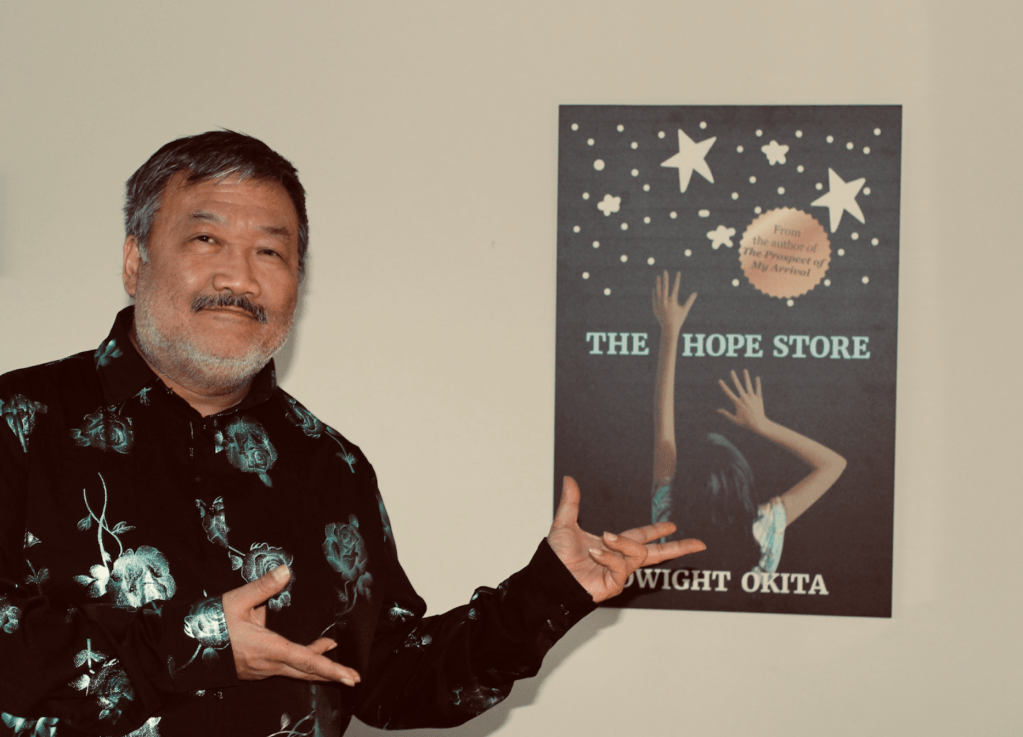
Dwight Okita points out the larger than life version of the cover for his 2017 novel, “The Hope Store.” (Photo by C. Schandelmeier, March 10, 2024).
“Let’s break it down, Cathleen,” he said. “Oppenheimer is about a white man who feels a little bad about creating a bomb that could’ve destroyed the world – and did destroy tons of Japanese civilians. A story of white guilt. Barbie is about a female doll that has an existential crisis when she realizes that humans actually die. She makes a decision that I found moving and heroic. Barbie was the movie the world didn’t know we needed to see! It was entertaining and hopeful after the endless pandemic.”
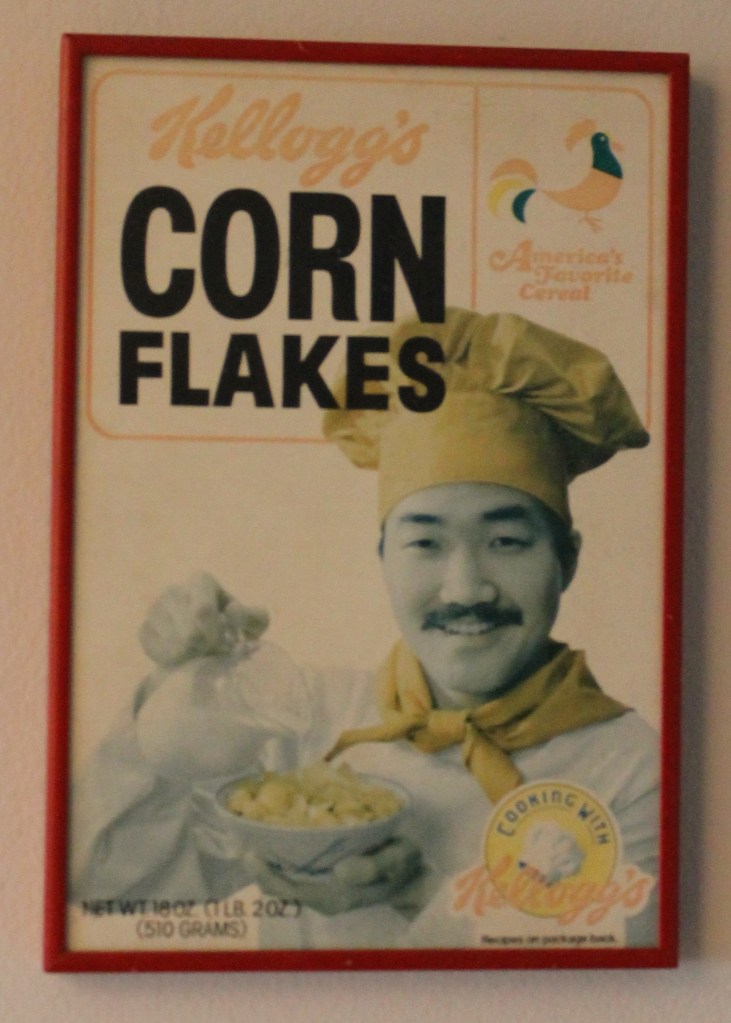
Dwight Okita’s cover on the Kellogg’s Corn Flakes box is proudly displayed in his Chicago home. (Photo by C. Schandelmeier, March, 10, 2024)
Okita shared a story about appearing on the cover of the Corn Flakes box. “Dad was a grade school teacher and he bought twenty boxes. He had me autograph them for his fellow teachers,” he said concealing a smile. Oddly, his father was less boastful about the first poem Okita got published, perhaps because it was in a small Chicago publication, whereas the cereal box was Kellogg’s after all. The poem “In Response to Executive Order 9066”(which refers to the order that caused Japanese Americans to be forcibly removed from their homes, and interned during World War II) went on to be included in scores of textbooks and in the Norton Introduction to Literature.
Okita has it, the gift of poetry, the ability to weave magic with words, the unique perspective of someone who tackles issues head-on while viewing them dreamily, from a distance in his fantasy land in the sky, where the dream factory of Hollywood colors and impacts his very real life. To learn more about Dwight Okita or his book go to his website at dwightokita.com.
Dwight Okita in his Chicago home on the 29th floor. (Photo by C. Schandelmeier, March 10, 2024).



















 Poetry in Chicago